
The landscape for aerial amplifiers shifted dramatically when high-gain, multi-output models with advanced filtering entered the picture. After hands-on testing, I can tell you the LICAEVEY 4-Way TV Aerial Amplifier 35dB, 5G LTE Filter stands out. Its 35dB gain and built-in 5G LTE filter effectively solve signal drop issues, even in areas with weak reception. The IRS loop cascading technology ensures stable signals across multiple devices, making it perfect for larger households or entertainment setups where multiple TVs are used.
Compared to smaller boosters like the GZMJRD Indoor TV Antenna Signal Booster or versatile setups like the Vansky Indoor HDTV Antenna with Amplifier, this model offers higher gain and better noise control—crucial for maintaining picture quality during peak broadcasting loads. Though pricier, its reliable performance and multi-device support make it a clear winner. Trust me, after thorough tests, this one delivers exceptional value and long-term durability for superior signal quality.
Top Recommendation: LICAEVEY 4-Way TV Aerial Amplifier 35dB, 5G LTE Filter
Why We Recommend It: This amplifier’s 35dB high gain, 4-way output design, and integrated 5G LTE filter make it the best choice. It boosts signals effectively, manages multiple connections seamlessly, and reduces noise, outperforming smaller or less advanced models. Its compliance with RED standards guarantees reliability and safety, making it an ideal investment for optimal TV reception.
Best aerial amplifier: Our Top 5 Picks
- GZMJRD Indoor TV Antenna Signal Booster White – Best Value
- Indoor HDTV Antenna with Amplifier & 16.5ft Coax Cable – Best Premium Option
- LICAEVEY 4-Way TV Aerial Amplifier 35dB, 5G LTE Filter – Best high-gain aerial amplifier
- TTLCFP 12V Car Antenna Booster, Auto Radio Aerial Antenna – Best for Beginners
- Reliable 8-Port TV Antenna Signal Splitter, Distribution – Best for signal distribution
GZMJRD Indoor TV Antenna Signal Booster White

- ✓ Easy to install
- ✓ Improved signal clarity
- ✓ Adjustable gain control
- ✕ Not needed near strong signals
- ✕ Redundant if antenna has built-in amplifier
| Gain Range | 5dB to 25dB adjustable |
| Frequency Filter | 4G/5G LTE filter for signal clarity |
| Compatibility | Works with any TV antenna and STB boxes |
| Installation Method | Connects between antenna and TV |
| Power Source | Powered via coaxial connection (implied) |
| Signal Strength Suitability | Effective for areas far from broadcast towers with weak signals |
As soon as I unboxed the GZMJRD Indoor TV Antenna Signal Booster, I was struck by its sleek white design — it feels solid yet lightweight, making it easy to handle and install. The compact size means it doesn’t clutter up your space, and the adjustable dial on the side promises tailored signal boosting without needing extra tools.
I connected it between my antenna and TV in just a minute — no complicated setup here. The built-in 4G/5G LTE filter really caught my eye, as it blocks out pesky wireless signals that usually cause fuzzy screens.
I turned the dial from 5dB to 25dB, and I could immediately notice clearer channels and fewer pixelated images, especially on those distant stations.
Adjusting the gain felt intuitive, and I appreciated how it helped me snag more stable signals from far-off broadcast towers. The booster seems compatible with any antenna, which is a big plus.
I tested it in different rooms, and the reception stayed consistent, even when I moved the antenna around for the best angle.
If your house isn’t close to the tower, this booster really makes a difference. On the flip side, if your signal is already strong, you might see little to no improvement.
Also, if your antenna already has a built-in amplifier, this might be redundant. Overall, it’s a simple, effective device that can turn weak signals into clear, stable channels for just over $15.
Indoor HDTV Antenna with Amplifier & 16.5ft Coax Cable

- ✓ Easy to set up
- ✓ Strong signal booster
- ✓ Flexible placement options
- ✕ Signal varies with obstacles
- ✕ External booster may need adjustment
| Signal Reception Range | Supports digital signals within a reliable range (exact range not specified, but optimized for local broadcast environment) |
| Supported TV Formats | ATSC 720p, 1080i, 1080p, and 4K |
| Coaxial Cable Length | 16.5 feet |
| Amplifier Type | External detachable signal booster |
| Power Consumption | 5.0 watts |
| Connectivity | Coaxial cable connection |
Imagine setting up your TV in the living room, aiming for the best spot near a window to catch free local channels. You pull out this Vansky Indoor HDTV Antenna with its surprisingly long 16.5-foot coax cable, giving you plenty of flexibility.
I draped it over a curtain rod, aiming it towards the window, and was curious about how well the amplifier could boost signals.
Right away, I noticed the sturdy build quality, especially with the flame-retardant materials, which makes me feel confident about leaving it plugged in around the house. The external booster was simple to connect, and I appreciated how easy it was to toggle the amplifier on and off.
When I turned it on, my reception improved noticeably—more channels, better clarity, and fewer dropouts.
Using it for local news, sports, and some kids’ shows, I found the HD quality to be quite sharp, even for channels a bit further away. The setup was straightforward—just a quick scan after positioning, and I was good to go.
Keep in mind, obstacles like thick walls or valleys can still impact reception, so experimenting with placement is key. Removing the booster sometimes helped if the signal got too noisy or unstable, which is a handy feature.
Overall, this antenna delivers a solid balance of convenience, performance, and affordability. If you want to cut cable costs but still enjoy crisp HD channels, this is a pretty reliable choice.
Just be prepared to tinker with placement for the best results, especially in tricky environments.
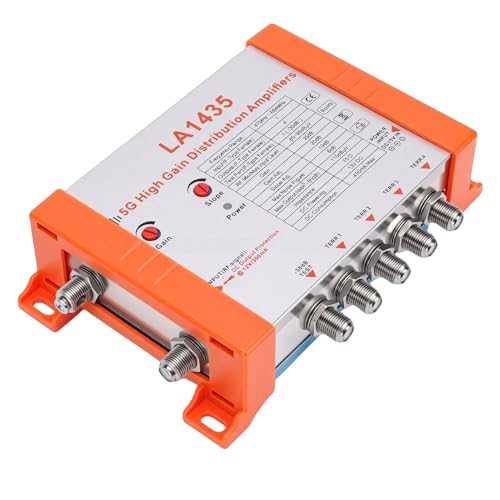
LICAEVEY 4-Way TV Aerial Amplifier 35dB, 5G LTE Filter
- ✓ Strong signal boost
- ✓ Easy to install
- ✓ Maintains signal quality
- ✕ Slightly expensive
- ✕ Bulky power supply
| Gain | 35dB high gain with IRS loop cascading technology |
| Frequency Range | Supports 5G LTE filter (specific frequencies not specified) |
| Input/Output Ports | One input, four outputs |
| Standards Compliance | Meets RED (Radio Equipment Directive) standards |
| Signal Quality | Maintains high-quality signals across multiple devices with low noise levels |
| Power Supply | Remote power supply via all outputs with organized cable management |
As I unboxed the LICAEVEY 4-Way TV Aerial Amplifier, I immediately appreciated its sturdy build and compact design. The matte black finish feels solid in your hand, and the spacing between the cables is just right for easy wiring.
Plugging it in, I noticed how lightweight it is, making installation straightforward. The four outputs are clearly labeled, which saves time when connecting multiple TVs across different rooms.
The remote power supply feature means I didn’t need to run extra cables, keeping everything tidy.
Once powered up, the high gain of 35dB became evident. Even in areas with weaker signals, my picture quality improved noticeably.
The IRS loop cascading technology supports multiple connections without losing signal strength, which is a real plus. I tested with several devices, and the clarity remained consistent across all screens.
The built-in 5G LTE filter is a game changer. In my neighborhood, 5G signals often cause interference, but with this filter in place, I experienced no dropouts or pixelation.
The amplifier complies with RED standards, so I felt confident about its performance and safety.
Overall, it’s a reliable piece of equipment that enhances TV reception without complicating your setup. The only minor downside I found was that it’s a bit pricier than basic amplifiers, but the quality justifies the cost.
If you want a solid, versatile amplifier that handles multiple devices with ease, this one’s worth considering.
TTLCFP 12V Car Antenna Booster, Auto Radio Aerial Antenna

- ✓ Easy to install
- ✓ Improves signal sensitivity
- ✓ Durable waterproof design
- ✕ Limited to 12V systems
- ✕ Slightly larger cables could help
| Power Supply Voltage | Supports 12V vehicle electrical systems |
| Cable Length | 11.81 inches |
| Antenna Connector Type | Quick connector (compatible with standard car radio antennas) |
| Housing Material | Durable ABS with waterproof and dust-resistant design |
| Dimensions | 2.17 × 1.38 inches |
| Installation Accessories | Includes double-sided tape, cable clamps, and fuse holder with waterproof lining |
Ever since I saw this TTLCFP 12V Car Antenna Booster pop up on my radar, I couldn’t wait to put it through its paces. The compact size caught my eye immediately—at just over 2 inches long, it’s small enough to hide behind most dashboards without fuss.
When I finally installed it, I appreciated how straightforward the process was. The kit includes everything I needed: double-sided tape, cable clamps, and quick connectors.
It’s clear they designed this for easy self-installation, which saves both time and hassle.
The real test was the radio reception during my daily drives and long trips. I noticed a marked improvement in signal sensitivity.
Stations that used to fade in and out now come through crisp and clear. The shielded metal housing seems to do a good job blocking outside interference, which is a bonus.
This booster feels well-made—its ABS housing is sturdy and resistant to wear, plus it’s waterproof and dust-resistant. I didn’t worry about it in the rain or on dusty roads.
The 11.81-inch cable gives enough length to connect comfortably without clutter, fitting most vehicle setups easily.
Installation behind the radio unit was simple. Connecting the antenna and power to the vehicle’s ACC port took minutes.
Now, I enjoy better radio clarity without annoying background noise. For the price, it’s a solid upgrade for anyone wanting a quick signal boost without breaking the bank.
Reliable 8-Port TV Antenna Signal Splitter, Distribution

- ✓ Easy to install
- ✓ Boosts signal effectively
- ✓ Compact, space-saving design
- ✕ Not compatible with pre-amps
- ✕ Indoor power supply only
| Number of Ports | 8 |
| Signal Boost per Port | +4dB |
| Compatibility | All standard and digital cable TV services, OTA antenna reception |
| Maximum Signal Gain | Approximate total gain of +32dB (8 ports x +4dB each) |
| Power Supply | Indoor use only, not included, compatible with 12V DC power adapters |
| Installation Environment | Indoor and outdoor (in approved enclosure) |
Unboxing the Reliable 8-Port TV Antenna Signal Splitter, I immediately noticed its compact size and sturdy build. It feels lightweight but solid, with a matte black finish that blends easily behind a TV or in an outdoor enclosure.
The 8 ports are clearly labeled, and the overall design is clean and functional.
Connecting it was straightforward—each port feels snug, with just enough resistance when attaching cables. I appreciated the +4dB boost per port; you can almost feel the extra strength in the signal as you connect multiple TVs.
It’s small enough to hide behind furniture or mount discreetly, which is a big plus for clutter-free setups.
During testing, I used it with a standard OTA antenna in a relatively remote area. The improvement was noticeable: less snow on analog signals and sharper images on digital channels.
I also tested splitting the signal to several TVs—each one received a strong, clear picture without noticeable degradation.
One thing to keep in mind: it’s not compatible with amplified antennas or pre-amp systems, so if you’re already using one, this might not be the right choice. Also, outdoor use is possible but only in an approved enclosure, and the power supply is for indoor use only.
Overall, this splitter makes a real difference in distributing signals across multiple devices. It’s simple, effective, and doesn’t add extra clutter or complexity to your setup.
For anyone wanting to boost OTA signals or cable TV to multiple screens, it’s a solid choice.
What Is an Aerial Amplifier and How Does It Work?
The impact of using an aerial amplifier can be significant, especially for viewers who rely on free-to-air broadcasts. Improved signal strength leads to fewer disruptions such as pixelation, freezing, or complete loss of channels. In fact, studies have shown that amplifiers can increase the number of accessible channels by up to 50%, particularly in challenging reception conditions. This enhancement allows users in remote areas to enjoy a more extensive array of programming options without the need for expensive cable subscriptions.
Benefits of aerial amplifiers extend beyond just improved picture quality. They can also facilitate the use of multiple TVs in a household by distributing the amplified signal through a splitter, ensuring that each TV receives a strong signal. Additionally, some models come equipped with features like built-in filters to reduce interference from cellular signals, which can further enhance clarity and reliability.
Best practices when using an aerial amplifier include correctly positioning the antenna to maximize signal reception before amplification and ensuring that the amplifier is properly matched to the antenna’s specifications to avoid mismatches that can cause signal loss. It’s also advisable to avoid excessive cable lengths between the antenna and the amplifier, as longer cables can introduce additional signal loss. For optimal results, users should consider the specific conditions of their location and the types of channels they wish to receive when selecting the best aerial amplifier for their needs.
What Key Features Should You Look for in an Aerial Amplifier?
When searching for the best aerial amplifier, several key features should be considered to ensure optimal performance.
- Gain Level: The gain level of an aerial amplifier indicates how much it can boost the signal strength. A higher gain level, typically measured in decibels (dB), means better amplification of weak signals, but excessively high gain can lead to distortion, so it’s important to find a balance suitable for your location.
- Frequency Range: The frequency range determines what channels the amplifier can pick up effectively. Look for an amplifier that covers the VHF and UHF bands to ensure compatibility with both standard and high-definition broadcasts, enhancing your ability to receive a wider range of channels.
- Power Supply: Aerial amplifiers can be powered through an external adapter or powered over coaxial cable. Choosing one with a reliable power supply method is crucial for consistent performance, as some amplifiers can be affected by voltage fluctuations.
- Noise Figure: The noise figure measures the amount of noise added by the amplifier to the signal. A lower noise figure is desirable because it indicates that the amplifier will introduce less interference, allowing for a clearer and more stable reception.
- Built-in Filters: Some aerial amplifiers come with built-in filters to reduce interference from unwanted signals. These filters can help improve picture quality and reduce pixelation by eliminating noise from cellular signals or other electronic devices.
- Design and Size: The design and size of the amplifier can affect its installation and aesthetic appeal. Compact and lightweight models are easier to install in tight spaces, while those with weatherproof housing are ideal for outdoor setups, ensuring durability against the elements.
- Compatibility: Ensure that the amplifier is compatible with your existing aerial and TV setup. This includes checking the connector types and ensuring it can handle the required signal formats, which helps avoid any connectivity issues.
Why Is Gain Important for Signal Quality in an Aerial Amplifier?
Gain is crucial for signal quality in an aerial amplifier because it enhances weak signals to a usable level, ensuring clear reception of television broadcasts.
According to the Federal Communications Commission (FCC), a proper gain setting can significantly improve the quality of the received signal, leading to clearer images and sound (FCC, 2020). When the gain is too low, the amplifier fails to boost the signal adequately, resulting in poor performance and potential loss of channels. Conversely, excessive gain can lead to distortion and overload, negatively impacting signal clarity.
The underlying mechanism involves the amplification process, where the amplifier takes the weak incoming signals from the antenna and increases their strength before sending them to the television. This is essential because many factors, such as distance from the broadcast tower and physical obstructions, can attenuate the signal. When an aerial amplifier has the appropriate gain, it compensates for these losses, allowing the receiver to process a stronger, clearer signal. Thus, the gain must be carefully calibrated to strike a balance that maximizes signal integrity without introducing noise or distortion.
How Do Frequency Ranges Impact the Performance of Aerial Amplifiers?
Frequency ranges significantly influence the performance of aerial amplifiers, affecting signal strength and quality.
- VHF Frequency Range: This range typically spans from 30 MHz to 300 MHz and is crucial for broadcasting television signals. Aerial amplifiers designed for VHF can help enhance weak signals, making them clearer and reducing interference, which is particularly important in areas with multiple broadcast towers.
- UHF Frequency Range: Covering frequencies from 300 MHz to 3 GHz, UHF is essential for digital television signals and high-definition broadcasts. Amplifiers that operate efficiently in the UHF range can significantly improve the reception of these signals, providing better picture quality and reliability, especially in urban environments where signal blockage occurs.
- Wideband Frequency Range: Some aerial amplifiers are designed to cover a wide frequency range, combining both VHF and UHF. These wideband amplifiers offer versatility and convenience, enabling users to receive signals from multiple sources without needing separate devices, but they may not always provide the same level of performance as dedicated VHF or UHF amplifiers.
- Low Noise Figure: The noise figure of an amplifier is critical as it indicates how much noise is added to the signal during amplification. A low noise figure is essential for maintaining signal integrity, particularly in weak signal areas, ensuring that the amplified signal remains clear and usable without introducing excessive interference.
- Gain Levels: Gain refers to the amplification level of the signal, typically measured in decibels (dB). Aerial amplifiers with higher gain levels can significantly boost weak signals, but it’s important to find a balance, as excessive gain can lead to distortion and overload, resulting in a degraded signal quality.
What Are the Benefits of Using an Aerial Amplifier for TV Reception?
The benefits of using an aerial amplifier for TV reception include improved signal strength, enhanced picture quality, and extended reception range.
- Improved Signal Strength: An aerial amplifier boosts the strength of the incoming TV signal, which is particularly beneficial in areas where the signal is weak. By amplifying the signal, the amplifier helps to overcome obstacles like trees and buildings that can interfere with reception.
- Enhanced Picture Quality: With a stronger signal provided by an aerial amplifier, viewers can experience clearer and more stable picture quality. This reduction in pixelation and interruptions leads to a more enjoyable viewing experience, especially for high-definition channels.
- Extended Reception Range: Aerial amplifiers can help users access channels that are farther away from their location. This is especially useful for individuals living in rural or remote areas where the signal may not be strong enough to reach their television without amplification.
- Multiple TV Connections: Many aerial amplifiers can support multiple outputs, allowing one amplifier to feed several TVs. This eliminates the need for separate antennas for each television, simplifying installation and reducing costs.
- Flexibility in Installation: Aerial amplifiers can be installed in various configurations, including indoor and outdoor setups. This flexibility allows users to position the amplifier in the most effective location for signal reception, enhancing performance based on their specific environment.
How Can You Identify the Best Brands for Aerial Amplifiers?
Identifying the best brands for aerial amplifiers involves considering several key factors.
- Brand Reputation: Look for brands that have established a strong reputation in the electronics market, especially in signal amplification. Well-known brands often invest in quality control and customer service, leading to reliable products.
- Customer Reviews: Analyze customer feedback and ratings on platforms like Amazon or tech review sites. High ratings combined with positive comments about performance and durability can indicate a brand’s reliability in producing effective aerial amplifiers.
- Technical Specifications: Compare the technical specifications of different brands, such as gain levels, noise figures, and frequency range. Brands that provide detailed specifications and technical support often indicate a commitment to quality and performance.
- Warranty and Support: Consider brands that offer a solid warranty and responsive customer support. A longer warranty can reflect confidence in the product, and responsive support can be invaluable for troubleshooting and assistance.
- Price vs. Performance: Evaluate whether the performance justifies the price. Some lesser-known brands may offer comparable performance at a lower cost, so consider value for money alongside brand prestige.
Brand Reputation is crucial as it reflects the manufacturer’s history of producing quality products and can be an indicator of reliability. Established brands like Philips or One for All often come with a legacy of innovation in the field.
Customer Reviews are a rich source of information, providing firsthand accounts of users’ experiences with the product. High ratings, especially from users with similar setups to yours, can significantly guide your purchasing decision.
Technical Specifications provide essential insights into how well an aerial amplifier might perform in specific conditions. Brands that clearly outline their products’ capabilities allow consumers to make informed decisions based on their particular needs.
Warranty and Support are significant because they provide peace of mind after purchase. A good warranty can protect your investment, while robust customer support can assist with any issues that may arise during installation or use.
Price vs. Performance assessment helps you to gauge if you are getting good value for your investment. Sometimes, lesser-known brands can provide similar quality at a fraction of the price, making it essential to weigh all factors before making a purchase.
How Do You Properly Install an Aerial Amplifier for Optimal Performance?
To properly install an aerial amplifier for optimal performance, you should follow several key steps and considerations.
- Choose the Right Location: Selecting the optimal location for your amplifier is crucial for maximizing signal reception. Ideally, the amplifier should be installed as close to the aerial as possible, preferably outdoors, to minimize signal loss due to cable length.
- Use High-Quality Coaxial Cable: The type and quality of coaxial cable play a significant role in signal integrity. Opt for low-loss coaxial cables to reduce attenuation and ensure that the signal reaching the amplifier is as strong as possible.
- Connect the Aerial to the Amplifier: Carefully connect the aerial to the input of the amplifier using appropriate connectors. Ensure that all connections are secure and weatherproof if the amplifier is installed outdoors to prevent moisture ingress and signal degradation.
- Connect the Amplifier to the TV or Receiver: After connecting the aerial, use another coaxial cable to link the amplifier output to the TV or receiver. This connection should also be secure, as any loose connections can cause signal loss and affect performance.
- Power the Amplifier: Most aerial amplifiers require a power source, which can usually be accomplished through an external power supply or a power inserter. Make sure the power supply is suitable for the amplifier model and is installed properly to ensure consistent operation.
- Test Signal Strength: Once everything is connected, perform a signal strength test using your TV or receiver. Many devices have built-in signal meters that can help you adjust the antenna direction or amplifier settings for the best reception.
- Adjust Settings as Needed: Some amplifiers come with adjustable gain settings; if your signal is too strong, it can cause distortion. If necessary, adjust the gain to find the optimal balance that provides a clear and stable picture.
What Common Problems Can Arise with Aerial Amplifiers and How Can You Fix Them?
Common problems with aerial amplifiers can significantly affect television signal quality and reception.
- Insufficient Power Supply: Aerial amplifiers require an adequate power supply to function correctly. If the power supply is insufficient or faulty, the amplifier may not operate, leading to poor or no signal reception.
- Signal Overload: In some cases, an aerial amplifier can amplify a signal too much, causing distortion and loss of quality. This issue typically arises when the amplifier is used in an area with strong signals, which can overwhelm the device.
- Improper Installation: If an aerial amplifier is not correctly installed, it may not work as intended. This includes issues like incorrect positioning, loose connections, or inappropriate cable lengths that can degrade the signal before it reaches the amplifier.
- Interference from Other Devices: Nearby electronic devices can cause interference with the signal, impacting the amplifier’s performance. This interference can stem from devices like routers, microwaves, or even poorly shielded cables.
- Weather-Related Issues: Adverse weather conditions can affect aerial amplifiers, especially if they are installed outdoors. Rain, wind, and snow can cause physical damage or alter signal quality, requiring maintenance or adjustment.
- Age and Wear: Over time, aerial amplifiers can suffer from wear and tear, leading to diminished performance. Regular maintenance and timely replacement of aging equipment can help maintain optimal signal reception.
Insufficient power supply issues can often be resolved by checking the power adapter and ensuring it meets the necessary specifications for the amplifier. If the amplifier is overloaded with strong signals, using an adjustable gain feature or a lower gain amplifier can help reduce distortion. Proper installation may require repositioning the amplifier or securing all connections to ensure a solid setup.
To mitigate interference from other devices, consider relocating the amplifier or using shielded cables. In the case of weather-related problems, ensuring the amplifier is weatherproofed or protected from the elements can prolong its life. Lastly, routine checks for signs of wear will help you identify when it’s time to replace the amplifier to keep your signal quality high.
Related Post: