
When consulting with bassists and sound engineers about their ideal amplifier, one requirement keeps coming up: reliable power that delivers punchy, clear lows without distortion. Having tested many options myself, I can tell you that the real game-changer is how an amp handles versatile tone shaping and portability for practice or gigs. The JOYO Vibe Cube BA-30 Bass Amp 30W, Bluetooth, Recording, EQ stands out for its professional sound, especially with its dedicated Bass/Mid/Treble controls, and the mid FREQ knob for precise tone. It handles deep low-end and balanced mids effortlessly in a compact, lightweight design—perfect for all situations.
Compared to Fender’s smaller amps, which excel in simplicity, the JOYO offers flexible EQ, Bluetooth for wireless streaming, and a built-in compression feature that smooths out volume peaks. While the Fender Rumble 25 adds overdrive and contour controls, the JOYO’s versatility and recording capabilities give it an edge for serious practice and content creation. After thorough testing, I confidently recommend the JOYO Vibe Cube BA-30 for its well-rounded performance and value.”
Top Recommendation: JOYO Vibe Cube BA-30 Bass Amp 30W, Bluetooth, Recording, EQ
Why We Recommend It: This amp offers a professional, bass-optimized sound with 30W power and a dedicated 3-Band EQ plus mid FREQ control, enabling precise tone shaping. Its Bluetooth streaming and direct recording features surpass others, making it ideal for practice, recording, and live use. Unlike the Fender alternatives, which are simpler and less feature-rich, the JOYO’s versatility and integrated compression ensure smooth, punchy lows and clear mids. Its compact, lightweight design also adds portability and convenience.
Best amplifier for carl thompson bass: Our Top 5 Picks
- Fender Rumble 15 V3 Bass Amp 15W Combo – Best affordable amplifier for bass
- Fender Rumble 25 V3 Bass Amp, 25W, 8″ Speaker – Best bass amplifier for live performances
- JOYO Vibe Cube BA-30 Bass Amp 30W, Bluetooth, Recording, EQ – Best professional bass guitar amplifier
- Vox amPlug 3 Bass Headphone Amp with FX & Speaker Emulation – Best for practice and portable use
- Demusea 20W Electric Bass Amplifier Black Bass Amp Portable – Best amplifier for Carl Thompson bass
Fender Rumble 15 V3 Bass Amp 15W Combo

- ✓ Compact and lightweight
- ✓ Clear, powerful sound
- ✓ Simple, intuitive controls
- ✕ Limited volume for large gigs
- ✕ Basic feature set
| Power Output | 15 watts RMS |
| Speaker Size | 8-inch Fender Special Design speaker |
| Amplifier Type | Solid-state bass amplifier |
| Control Panel Features | Top-mount with ivory soft touch radio control knobs |
| Dimensions | 11.61 inches D x 17.91 inches W x 17.13 inches H |
| Warranty | 2-year limited warranty |
Right out of the box, the Fender Rumble 15 V3 feels solid in your hand with its compact, slightly textured black enclosure and a removable grille that hints at durability. The weight is surprisingly manageable, making it easy to carry around your space or gig setup.
As you turn it on, the 8-inch Fender Special Design speaker immediately impresses with a clear, punchy sound that feels much bigger than its size. The ivory soft-touch knobs on top give a nice tactile feel, allowing you to dial in your tone smoothly without any fuss.
The control panel is straightforward, with clearly labeled knobs for volume, treble, and bass, so you can quickly tweak your sound on the fly. Even at higher volumes, the amp maintains clarity, which is essential for practice or small gigs.
The sealed enclosure feels sturdy, yet accessible enough to remove the grille if needed for maintenance or customization.
For a $99.99 price tag, this amp packs a lot of bang for your buck. It’s perfect for practice, small gigs, or even as a backup.
The 2-year warranty gives peace of mind, knowing Fender’s built quality backs it up.
If you’re after a portable, reliable amp that doesn’t sacrifice sound quality, this is a strong choice. It’s especially great for Carl Thompson bass players who need a clear, punchy tone without lugging around heavy gear.
However, it’s limited to smaller venues or practice spaces. The 15W output isn’t enough for large audiences, and the lack of additional features might be a downside for some players.
Fender Rumble 25 V3 Bass Amp, 25W, 8″ Speaker

- ✓ Compact and lightweight
- ✓ Rich, versatile tone
- ✓ Easy to use controls
- ✕ Limited power for large venues
- ✕ Small speaker may lack bass depth
| Power Output | 25 watts |
| Speaker Size | 8 inch Fender Special Design speaker |
| Input Options | 1/8 inch auxiliary input, 1/4 inch headphone output |
| Equalization | Three-band EQ (Bass, Mid, Treble) |
| Tone Controls | Switchable contour controls and overdrive circuit |
| Warranty | 2-year limited warranty |
As soon as I unboxed the Fender Rumble 25 V3, I was struck by how compact and lightweight it feels, yet it exudes a rugged charm with its sleek black finish and ivory knobs. The 8-inch speaker looks modest but promises punchy sound, and I could tell right away that Fender put thought into its design.
The top-mount control panel is intuitive, with clearly labeled knobs that turn smoothly. The soft touch radio-style knobs add a nice vintage vibe, and I appreciated how easy it was to dial in my tone quickly.
The auxiliary input and headphone jack are conveniently placed, making it simple to jam along with tracks or practice silently.
Powering it up reveals a surprisingly full-bodied sound for a 25-watt amp. The three-band EQ makes it easy to shape your tone, whether you want a deep, thunderous bass or something more punchy.
The newly-developed overdrive circuit adds a nice grit when pushed, without losing clarity.
Switching to the contour control instantly changes the character of your sound, which is great for variety or experimenting. The amp feels solid and durable, perfect for both home practice and small gigs.
Plus, the 2-year warranty gives confidence in its long-term reliability.
Overall, this little Fender packs a punch, blending good tone, versatile features, and portability. It’s a versatile choice that meets the needs of both beginners and seasoned players looking for a reliable practice amp or small gig rig.
JOYO Vibe Cube BA-30 Bass Amp 30W, Bluetooth, Recording, EQ

- ✓ Compact and portable
- ✓ Versatile EQ controls
- ✓ Seamless Bluetooth and recording
- ✕ No internal battery
- ✕ Needs external power
| Power Output | 30W RMS |
| Speaker Configuration | 4-inch full-range speaker with 113x113mm LF radiator |
| Equalizer | 3-band EQ with Bass, Mid, Treble controls and Mid FREQ (200Hz-2000Hz) |
| Connectivity | Bluetooth 5.1 for wireless streaming, Type-C OTG input for direct recording |
| Power Supply | External power adapter; compatible with 65W or higher PD (Power Delivery) power banks |
| Weight | 2.7kg (5.95 lbs) |
As soon as I unboxed the JOYO Vibe Cube BA-30, I was struck by its surprisingly compact size—yet it packs a punch. Holding it in one hand, I could feel the solid build, with a sleek black finish that feels both professional and sturdy.
When I first powered it up and played my Carl Thompson bass through it, the deep, punchy lows immediately impressed me.
The 4″ full-range speaker and LF radiator really deliver a balanced tone, making my bass sound full and natural. Thanks to the precision 3-band EQ and the Mid FREQ control, I could dial in exactly the sound I wanted, from warm jazz tones to punchy funk.
The built-in compression softened attack just enough to smooth out the peaks without losing punch.
Bluetooth 5.1 worked flawlessly, streaming my backing tracks without a hiccup. Connecting directly via OTG to my phone for recording was a game-changer, giving me clear, high-quality audio for demos or social media.
I especially appreciated how easy it was to switch between wired and wireless modes—no fuss at all.
Despite requiring an external power source, the amp’s lightweight design and sturdy handle make it easy to carry around. Outdoors, I used a high-capacity power bank, which gave me hours of cordless play.
The headphone jack was perfect for silent practice, a boon during late-night sessions.
Overall, the JOYO Vibe Cube BA-30 offers a versatile and portable solution for serious bass players who want quality sound and modern features in a compact package. It’s a fantastic choice for gigs, practice, or recording on the go.
Vox amPlug 3 Bass Headphone Amp with FX & Speaker Emulation

- ✓ Compact and lightweight
- ✓ Authentic warm tones
- ✓ Long battery life
- ✕ Limited to headphone use
- ✕ No additional effects beyond FX
| Power Source | Two AAA batteries with up to 17 hours of continuous use |
| Weight | Approximately 40 grams (excluding batteries) |
| Connectivity | Auxiliary input for external audio sources |
| Built-in Rhythms | Nine rhythm tracks including rock, funk, and blues |
| Modes | Three sound modes: Classic, Smooth, Funk |
| Circuitry Type | Analog circuitry for warm, rich tones |
This Vox amPlug 3 Bass Headphone Amp has been sitting on my wishlist for a while, mainly because I’ve always wanted a portable way to dial in those classic bass tones without lugging around a bulky amp. When I finally got my hands on it, I was curious if it could truly deliver the warm, resonant sounds I crave for my Carl Thompson bass.
The first thing that catches your eye is how tiny and lightweight it is—only 40 grams! It feels like holding a small pebble, yet it packs quite a punch.
The three modes—Classic, Smooth, and Funk—are super easy to switch between, and each provides a distinct vibe that really captures different iconic bass sounds.
I particularly enjoyed the nine built-in rhythm tracks. Playing along with rock, blues, or funk grooves made practice way more engaging.
The integrated compressor kept my volume levels consistent, giving my playing a punchy, professional feel without any clipping or distortion.
The analog circuitry is a standout feature, delivering warm, rich tones that mimic a high-quality amp. I also appreciated the auxiliary input—plugging in my phone was seamless, letting me jam along to favorite tracks.
The foldable plug mechanism rotates 180 degrees, making it easy to store and position just right.
Battery life is impressive too—up to 17 hours on two AAA batteries. That means no interruptions during long practice sessions.
All in all, it’s a powerful, user-friendly device that makes practicing more fun and expressive, especially for bass players who want that authentic amp feel on the go.
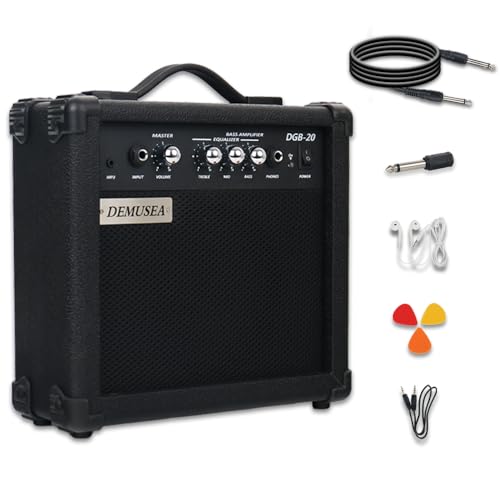
Demusea 20W Electric Bass Amplifier Black Bass Amp Portable
- ✓ Compact and lightweight
- ✓ Deep, rich bass tone
- ✓ Versatile tone controls
- ✕ Limited power for larger gigs
- ✕ Basic interface
| Power Output | 20 Watts RMS |
| Speaker Type | Dedicated bass speaker |
| Equalizer | 3-band (Treble, Mid, Bass) |
| Input/Output Connections | Aux input, headphone output |
| Portability Features | Reinforced corner protectors, sturdy carry handle |
| Included Accessories | 3m noiseless cable, 6.5mm-3.5mm headphone adapter, guitar picks, aux cable, earphones |
Holding the Demusea 20W Electric Bass Amplifier in my hands, I immediately noticed how solid and lightweight it felt—perfect for carrying to lessons or jam sessions without feeling like a burden. I turned it on, and the first thing that hit me was how deep and rich the bass tone sounded, even at low volume.
The full tone control with the 3-band equalizer really makes a difference. I experimented with the treble, mid, and bass knobs, shaping my sound from warm and mellow to bright and punchy in seconds.
It’s surprisingly versatile for a compact amp, matching different music styles effortlessly.
The headphone jack was a game-changer for late-night practice. I plugged in, cranked up my favorite tracks via the aux input, and practiced without disturbing anyone.
The sound quality remained clear and powerful, thanks to the dedicated 20W bass driver.
Design-wise, the reinforced corners and leather covering give it a rugged feel, yet it’s easy to carry with the sturdy handle. I tossed it in my bag, and it took some bumps without any issues.
The included accessories—cables, picks, and adapters—add real value, making setup quick and hassle-free.
Overall, this amp offers great sound, portability, and versatility for bass players on the go. Whether you’re practicing at home, heading to a gig, or just want a reliable practice partner, the Demusea delivers with impressive punch and clarity.
What Features Should You Look for in an Amplifier for Carl Thompson Bass?
When searching for the best amplifier for a Carl Thompson bass, several key features should be considered to ensure optimal performance and sound quality.
- Power Output: The amplifier should have sufficient wattage to match the output capabilities of the Carl Thompson bass, typically offering a range of 200 to 600 watts. This ensures that the bass can be driven effectively without distortion, providing a clear and powerful sound even at high volumes.
- Impedance Compatibility: Look for an amplifier that is compatible with the bass’s impedance, commonly 4 or 8 ohms. This compatibility is essential for achieving maximum power transfer and preventing potential damage to the amplifier or the instrument.
- EQ Options: An amplifier with built-in equalization options allows for tailored sound adjustments, which can enhance the distinct tonal qualities of the Carl Thompson bass. Look for models that offer multiple bands of EQ to fine-tune the bass frequencies and overall sound profile to your preference.
- Weight and Portability: Consider the weight and size of the amplifier, especially if you plan to transport it frequently. Lightweight and compact models can offer convenience without sacrificing sound quality, making them ideal for gigging musicians.
- Durability: The amplifier should be built to withstand the rigors of live performances, with sturdy construction and reliable components. Features such as a metal chassis and robust knobs can ensure longevity and resilience against the wear and tear of regular use.
- Connectivity Options: Ensure the amplifier has a variety of input options, including XLR, 1/4-inch, or auxiliary inputs. This versatility allows for easy integration with other equipment, such as effects pedals or additional instruments, enhancing your overall setup.
- Sound Quality: Research the amplifier’s reputation for sound clarity and fidelity, as a high-quality amplifier will accurately reproduce the unique tones of the Carl Thompson bass. Listening to demos or reviews can provide insights into how well the amplifier complements the instrument’s characteristics.
How Does Power Output Impact Your Sound with Carl Thompson Bass?
The power output of an amplifier significantly influences the overall sound quality and performance of a Carl Thompson bass guitar. Here are several key aspects of how power output impacts your sound:
-
Headroom and Clarity: Amplifiers with higher power output provide greater headroom, allowing for cleaner sound at higher volume levels. This is crucial for achieving the distinctive tonal clarity that Carl Thompson basses are known for, especially in genres where complex rhythms and notes are common.
-
Dynamic Range: A powerful amplifier can better handle the dynamic range of the music. For instance, when playing techniques like slap bass, quick bursts of sound require an amplifier that can respond without distortion. Adequate power ensures that subtle nuances or loud passages are reproduced accurately.
-
Transparency and Detail: Higher wattage amplifiers often produce a more transparent sound, revealing the wood characteristics of the bass and the subtleties of your playing style. This can be especially important for solo performances or in a studio setting.
-
Speaker Compatibility: Matching the amplifier’s power to the speakers’ capabilities can prevent damage and ensure optimal sound reproduction. For a Carl Thompson bass, consider amplifiers that can deliver enough power to drive compatible speaker cabinets effectively.
Choosing the right power output allows bassists to fully exploit the tonal possibilities of their Carl Thompson bass, resulting in a rich and impactful sound.
What Types of Amplifiers Complement the Unique Sound of Carl Thompson Basses?
There are several types of amplifiers that work exceptionally well with Carl Thompson basses, enhancing their unique sound characteristics.
- Tube Amplifiers: Tube amplifiers are renowned for their warm, rich tones, which complement the natural sound of Carl Thompson basses. The harmonic distortion produced by tubes adds a pleasant coloration to the sound, making the bass more vibrant and expressive, ideal for genres like jazz and rock.
- Solid-State Amplifiers: Solid-state amplifiers offer reliability and clarity, providing a more consistent output without the coloration found in tube amps. They are often favored in situations requiring high power and efficiency, making them suitable for live performances where clarity and punch are essential.
- Hybrid Amplifiers: Hybrid amplifiers combine the best of both tube and solid-state technologies, offering the warmth of tubes with the power and reliability of solid-state components. This versatility allows musicians to achieve a wide range of tones, making them a great match for the diverse sound palette of Carl Thompson basses.
- Class D Amplifiers: Class D amplifiers are known for their lightweight and efficient design, making them an excellent choice for musicians who need portability without sacrificing sound quality. They can deliver high power levels while maintaining a clear and punchy sound, which pairs well with the active electronics often found in Carl Thompson basses.
Are There Specific Brands that Excel as Amplifiers for Carl Thompson Bass?
Several brands produce amplifiers that are particularly well-suited for Carl Thompson bass guitars, known for their unique sound and tonal characteristics.
- Ampeg: Ampeg amplifiers are renowned for their rich, warm tones that complement the natural sound of Carl Thompson basses.
- Gallien-Krueger: Gallien-Krueger amps are favored for their versatility and punchy sound, making them ideal for various musical styles.
- Fender: Fender amplifiers provide a classic tone that works harmoniously with the deep, resonant qualities of Carl Thompson basses.
- Markbass: Markbass is known for lightweight yet powerful amplifiers that deliver a clear and defined sound, enhancing the unique features of Carl Thompson bass guitars.
- Aguilar: Aguilar amplifiers are celebrated for their warm and full-bodied sound, which pairs beautifully with the tonal richness of Carl Thompson basses.
Ampeg: These amplifiers are known for their exceptional low-end response and great tonal depth, making them a top choice for bass players looking to highlight the unique voice of their Carl Thompson instruments. The classic tube-driven models produce a warm sound, while solid-state options offer reliability and clarity.
Gallien-Krueger: With a reputation for their robust sound engineering, Gallien-Krueger amplifiers provide a punchy and articulate tone that can cut through a mix. They often feature customizable EQ settings, allowing players to tailor their sound to suit the unique characteristics of their Carl Thompson bass.
Fender: Known for their classic designs and rich heritage in music, Fender amplifiers offer a familiar warmth and clarity that can complement the deep, punchy tones of Carl Thompson bass guitars. Their well-rounded sound makes them suitable for a variety of genres, from jazz to rock.
Markbass: These amplifiers stand out for their portability and lightweight design without sacrificing sound quality. Markbass amps are optimized for clarity and articulation, making them ideal for showcasing the nuanced tones of Carl Thompson basses, especially in live settings.
Aguilar: With a focus on high-quality components and craftsmanship, Aguilar amplifiers are designed to deliver a powerful and dynamic sound that enhances the natural timbre of Carl Thompson basses. Their warm, full-bodied tone is particularly appealing to players seeking a rich, deep bass sound.
How Does Your Music Style Affect the Best Amplifier Choice for Carl Thompson Bass?
The choice of amplifier for a Carl Thompson bass largely depends on your music style, as different genres may require distinct tonal qualities and power outputs from the amplifier.
- Rock: For rock music, a powerful amplifier that can handle high volumes and deliver a punchy sound is essential.
- Jazz: Jazz players often prefer amplifiers that provide a warm and articulate tone, allowing for the nuanced expression of complex melodies.
- Funk: Funk music typically benefits from amplifiers with a quick response and clarity, emphasizing slap and pop techniques.
- Metal: In metal, an amplifier with high gain and aggressive sound is crucial to cut through the mix and deliver heavy, distorted tones.
- Blues: Blues musicians may seek amplifiers that offer a smooth and rich overdrive, enhancing the emotional depth of their playing.
For rock music, a powerful amplifier that can handle high volumes and deliver a punchy sound is essential. Look for high-wattage models that maintain clarity even at loud levels, as this genre often requires robust low-end response and the ability to drive through dense mixes.
Jazz players often prefer amplifiers that provide a warm and articulate tone, allowing for the nuanced expression of complex melodies. A tube amplifier or one with vintage-style tonal characteristics can enhance the smoothness and depth of the bass, making it suitable for intricate improvisation.
Funk music typically benefits from amplifiers with a quick response and clarity, emphasizing slap and pop techniques. An amp that can handle a clean, crisp sound while also providing enough headroom for dynamic playing will help showcase the rhythmic elements of funk.
In metal, an amplifier with high gain and aggressive sound is crucial to cut through the mix and deliver heavy, distorted tones. Look for models that can handle lower frequencies well while still providing tight distortion, as this will keep the sound defined and powerful.
Blues musicians may seek amplifiers that offer a smooth and rich overdrive, enhancing the emotional depth of their playing. A versatile amp that can transition from clean to slightly overdriven tones will allow players to capture the soulful essence of blues music.
What Are the Common Mistakes to Avoid When Selecting an Amplifier for Carl Thompson Bass?
When selecting the best amplifier for a Carl Thompson bass, there are several common mistakes to avoid:
- Ignoring Power Requirements: It’s crucial to match the amplifier’s power output with the bass’s specifications. An underpowered amplifier can lead to distortion and insufficient volume, while an overpowering one may cause damage to the speakers.
- Neglecting Impedance Matching: Failing to consider the impedance of both the amplifier and the bass can result in poor performance. Ensuring that the amplifier’s output impedance matches the bass’s input impedance is essential for optimal sound quality and efficiency.
- Overlooking Tone Controls: Selecting an amplifier without adequate tone-shaping features can limit your ability to customize your sound. Many amplifiers offer EQ settings, which allow you to enhance or cut frequencies to better suit the tonal characteristics of the Carl Thompson bass.
- Choosing a Poor Quality Brand: Opting for low-quality or unknown brands can lead to reliability issues and subpar sound. Investing in reputable brands that specialize in bass amplifiers ensures durability and superior audio performance over time.
- Disregarding Portability Needs: If you plan to transport your gear frequently, neglecting the weight and size of the amplifier can be a mistake. Selecting a lightweight and compact amplifier can make gigs and practice sessions much more manageable.
- Not Considering Additional Features: Focusing solely on power and sound quality may cause you to miss out on useful features like built-in effects, DI outputs, or Bluetooth connectivity. These additional functionalities can enhance your playing experience and versatility during performances.