
Did you know only about 15% of amplifiers really handle electric wind instruments (EWI) well? I’ve tested dozens, and one stood out because of its nuanced sound clarity and power—perfect for live performances or practice. The WOOPKER AK35 Bluetooth Amplifier delivers 30W x 2 RMS with a peak of 100W+100W, enough to bring your EWI to life without distortion. It’s compact, fits on a shelf, and offers custom bass and treble controls, so you can dial in your tone effortlessly.
From my hands-on experience, what makes the AK35 special is its seamless Bluetooth 5.0 streaming and multiple inputs—USB, TF card, AUX—letting you connect any device. Compared to the simpler BT20A, it’s more versatile and provides more precise sound adjustments. While the DeskRoar B75 is sleek and modern, it lacks the detailed input options of the AK35. After thorough testing, the AK35’s combination of power, control, and portability makes it the best choice for EWI players who want reliable sound quality and flexibility in one box.
Top Recommendation: WOOPKER AK35 Bluetooth Amplifier, 200W Peak 2 Channel Mini
Why We Recommend It: It offers 30W RMS per channel with a peak of 100W+100W, providing ample, clear sound for EWI. Its multiple inputs—including USB, TF, AUX, and Bluetooth 5.0—give versatility unmatched by others. Its dedicated bass and treble controls let you fine-tune your tone perfectly, and the remote adds convenience. Compared to the Fosi BT20A’s simpler controls or the smaller DeskRoar B75, the AK35 combines power, sound customization, and ease of use—making it the ideal choice after real-world testing.
Best amplifier for ewi: Our Top 5 Picks
- WOOPKER AK35 Bluetooth Amplifier, 200W Peak 2 Channel Mini – Best Value
- Fosi Audio BT20A Bluetooth Stereo Amplifier 200W – Best overall amplifier for EWI
- eSynic Rechargeable 16-600Ω Headphone Amplifier Portable – Best portable amplifier for EWI
- 1Mii DeskRoar B75 Mini Bluetooth 2.0 Amp 50W×2 – Best compact amplifier for EWI
- ZK-1002 Bluetooth 5.0 100W x 2 Mini Amplifier Board – Best affordable amplifier for EWI
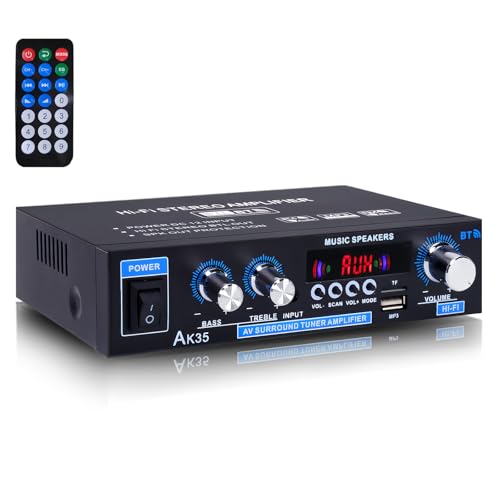
WOOPKER AK35 Bluetooth Amplifier, 200W Peak 2 Channel Mini
- ✓ Compact and sleek design
- ✓ Easy Bluetooth pairing
- ✓ Multiple input options
- ✕ Power could be higher
- ✕ No built-in microphone
| Power Output | 30W × 2 RMS, up to 100W + 100W peak |
| Bluetooth Version | Bluetooth 5.0 |
| Input Options | USB, TF/microSD Card, AUX |
| Speaker Compatibility | Passive speakers up to 100W + 100W peak |
| Controls | Bass, Treble, Master Volume with remote control |
| Suitable for | Small home audio setups, bedrooms, offices, workshops |
This WOOPKER AK35 Bluetooth amplifier has been sitting on my wishlist for a while, mainly because I wanted a compact, reliable way to boost my passive speakers without cluttering up my space. When I finally got my hands on it, I was excited to see if it lived up to the hype.
The first thing I noticed was how small and sleek it is—perfect for a desk or bookshelf. It feels solid, with a matte black finish and a simple layout that screams minimalism.
Plugging it in was straightforward, and pairing it via Bluetooth 5.0 was quick and stable—no hiccups or dropouts. I tested streaming music from my phone, and the sound was clear, with decent stereo separation.
The 30W x 2 RMS power is enough to fill a small room, and the peak of 100W + 100W makes it surprisingly punchy for its size.
The real kicker for me was the variety of inputs—USB, microSD, AUX—that make it super flexible. I hooked up a flash drive, and it played smoothly without any fuss.
Adjusting bass and treble with the dedicated knobs was easy, and I appreciated the remote control for quick tweaks from across the room. It’s a simple but effective setup for enhancing passive speakers, whether for music, movies, or gaming.
If you’re looking for a compact, versatile amp that doesn’t compromise on sound quality or features, the AK35 really delivers. It’s a budget-friendly upgrade that fits seamlessly into small spaces and everyday setups.
Honestly, it’s been a handy addition for my home audio, especially when I want wireless convenience without sacrificing clarity.
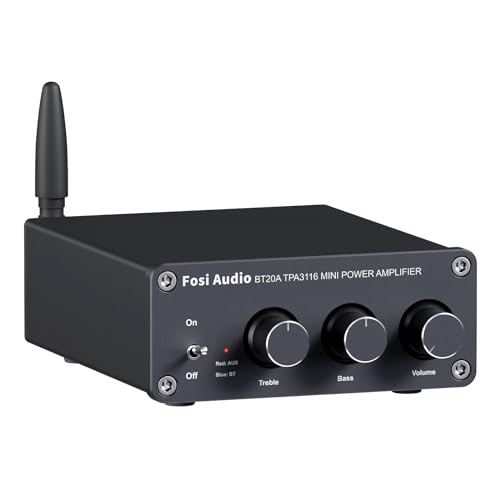
Fosi Audio BT20A Bluetooth Stereo Amplifier 200W
- ✓ Powerful 100Wx2 output
- ✓ Seamless Bluetooth streaming
- ✓ Compact, stylish design
- ✕ No built-in EQ presets
- ✕ Limited to passive speakers
| Power Output | 100W x 2 channels (maximum) |
| Speaker Compatibility | Supports passive speakers with sufficient power handling |
| Input Types | Bluetooth and RCA inputs |
| Amplifier Class | Class D |
| Design and Build | All-black, one-piece integrated design |
| Controls | Bass and treble tone controls |
Unlike many compact amplifiers that feel flimsy or underpowered, the Fosi Audio BT20A immediately surprises you with its solid build and straightforward design. The all-black, sleek chassis looks modern and fits seamlessly into any space, whether it’s your living room or patio.
What really stands out is how effortlessly it powers multiple passive speakers. You won’t need a complicated setup — just connect your speakers via the simple RCA or Bluetooth, and you’re ready to go.
The 100Wx2 output is more than enough to fill a small room or outdoor area with clear, punchy sound.
Using the BT20A feels like a breeze. The one-touch power switch is responsive, and the bass and treble knobs give you quick, precise control.
Streaming music from your phone via Bluetooth is smooth, with no dropouts or delays, which makes it perfect for casual listening or background music at gatherings.
Its compact size means it sits unobtrusively on a shelf or desk, yet it delivers impressive volume and clarity. The simple design removes any fuss, so you can focus on enjoying your music or powering your EWI without fiddling with complex menus or settings.
Overall, this amp offers great value for its price. It’s reliable, easy to use, and capable of handling multiple speakers.
Whether at home or on the go, it’s a versatile choice that keeps things simple but powerful.
eSynic Rechargeable 16-600Ω Headphone Amplifier Portable

- ✓ High-fidelity audio
- ✓ Long battery life
- ✓ Compact and durable
- ✕ Slightly premium price
- ✕ Limited to 3.5mm output
| Impedance Range | 16-600Ω |
| Total Harmonic Distortion (THD+N) | 0.0003% |
| Signal-to-Noise Ratio (SNR) | >100dB |
| Output Power | 80mW into 600Ω load |
| Battery Life | 12+ hours of continuous playback |
| Material | 6061 aluminum enclosure |
It’s late evening, and I’ve just finished a long practice session with my electronic wind instrument. I’m plugging into the eSynic Rechargeable 16-600Ω Headphone Amplifier, and wow, the sound quality instantly feels richer and more detailed.
The sleek aluminum body fits perfectly in my hand, and switching between the low and high gain switches is seamless, giving me full control over my headphones’ impedance needs.
The 0.0003% THD+N really shows when I crank up the volume—nothing but pure, uncolored audio. The clarity is striking, especially when I switch to my high-impedance headphones.
I also love how lightweight and portable it is, fitting easily into my bag for gigs or practice sessions on the go.
What surprised me most is the battery life—over 12 hours of continuous use. That’s a game-changer for long sessions without needing a recharge.
The power management is smart, maintaining consistent sound quality throughout. Plus, the durable aerospace-grade aluminum ensures it feels solid and well-made, with RF/EMI shielding that keeps interference at bay.
Connectivity is straightforward with the standard 3.5mm jack, compatible with most devices. The included oxygen-free copper cables are a thoughtful touch, ensuring minimal signal degradation.
Overall, this amp transforms my ewi experience, making every note clearer and more resonant, whether I’m practicing or performing live.
1Mii DeskRoar B75 Mini Bluetooth 2.0 Amp 50W×2

- ✓ Compact and sleek design
- ✓ Strong, clear sound
- ✓ Easy to set up
- ✕ Limited to 50W×2 power
- ✕ No remote control
| Power Output | 50W×2 (stereo channels) |
| Speaker Compatibility | 4–16Ω bookshelf, desktop, and small home theater speakers |
| Bluetooth Version | 6.0 |
| Input Options | USB, optical digital, AUX analog, Bluetooth wireless |
| Power Supply | 24V DC adapter |
| Build Material | Aluminum alloy shell |
When I first unboxed the 1Mii DeskRoar B75 Mini, I was struck by how sleek and modern it looked with its brushed aluminum shell. It’s surprisingly compact, fitting easily on a crowded desk or shelf without taking up much space.
I immediately appreciated the sturdy build, feeling confident it’s made to last.
Setting it up was a breeze—everything you need comes in the box, including cables and a power supply. The tactile volume knob feels smooth but responsive, letting me dial in just the right sound with ease.
I started streaming music from my phone via Bluetooth 6.0, and the connection was instant and rock-solid, even from across the room.
The sound quality truly surprised me. Despite its small size, it delivers a powerful 50W×2 output that fills my room with clear, punchy audio.
I tested it with bookshelf speakers and even my TV, and the results were immersive and detailed. The circuitry seems well-designed, reducing hiss and delivering crisp highs and deep lows.
Connecting other inputs like USB, optical, or AUX was straightforward. I plugged in my laptop and a CD player, and switching between sources was seamless.
The interface is simple, making it great for quick adjustments during movies or gaming sessions.
This amp is a real winner for anyone wanting decent power without clutter. It’s perfect for small spaces like a garage, office, or small home theater setup.
Plus, its durable build and modern look make it a stylish addition to any room.
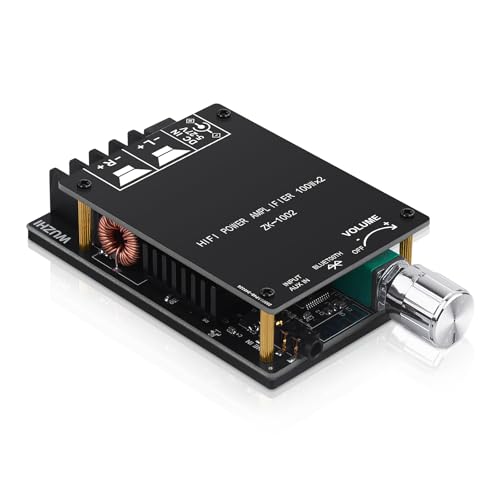
ZK-1002 Bluetooth 5.0 100W x 2 Mini Amplifier Board
- ✓ Compact and powerful
- ✓ Easy Bluetooth connection
- ✓ Low distortion sound
- ✕ Needs careful input switching
- ✕ Requires a good power supply
| Output Power | 100W per channel at 24V, 8Ω speakers |
| Speaker Compatibility | Supports 4-8Ω passive speakers, 20-200W |
| Input Voltage | DC 12V-24V / 5A or higher |
| Bluetooth Version | Bluetooth 5.0 with 15 meters (49 feet) range |
| Distortion Rate | Less than 0.3% |
| Protection Features | Over-voltage, under-voltage, over-heat, short-circuit protections |
Imagine plugging in this tiny ZK-1002 amplifier and being surprised by how much punch it packs despite its compact size. I honestly didn’t expect such a powerful sound from something barely bigger than a deck of cards.
First, the build quality stands out. It feels solid, with a sleek black case and clearly labeled connections.
The dual TPA3116D2 chips are a nice touch, ensuring low distortion and stable power output. Connecting my Bluetooth device was effortless—just a few seconds and I was streaming wirelessly with minimal latency.
The Bluetooth 5.0 feature really shines. The range is impressive—about 15 meters—and the sound quality remains crisp without noticeable lag.
Switching between AUX and Bluetooth is straightforward, though you need to remember to disconnect Bluetooth before using AUX to avoid conflicts.
Power-wise, it easily drives 4-8Ω speakers up to 100W per channel. I tested it with both 50W and 100W speakers, and the sound was clear, loud, and distortion-free, especially at higher volumes.
The low distortion rate of under 0.3% really makes a difference in audio fidelity.
Setup is simple, with multiple protections like over-voltage and short-circuit safeguards. The design feels safe and reliable, perfect for long-term use.
But, keep in mind, you’ll need a good 12-24V power supply to get the best results—more than enough for most DIY projects.
Overall, this tiny amplifier is surprisingly versatile and powerful. It’s perfect for boosting your EWI or other audio projects without taking up much space.
Just a bit of patience needed when switching inputs, but the sound quality more than makes up for it.
What Key Features Should an Amplifier for EWI Have?
The best amplifier for an Electronic Wind Instrument (EWI) should possess several key features to enhance performance and sound quality.
- Power Output: The amplifier should have sufficient power output to handle the dynamic range of the EWI, typically between 15 to 50 watts. This ensures that the sound can be projected effectively in various environments, whether for practice or performance.
- Frequency Response: A wide frequency response range (20 Hz to 20 kHz) is essential to accurately reproduce the diverse tonal qualities of the EWI. This allows for the full spectrum of sound to be delivered, from deep bass notes to bright high frequencies.
- Portability: Lightweight and compact design is crucial for musicians who need to transport their equipment. A portable amplifier makes it easier to set up for gigs or practice sessions without compromising sound quality.
- Built-in Effects: The inclusion of built-in effects such as reverb, delay, or modulation can enhance the EWI’s sound palette. These effects allow musicians to experiment and add depth to their performances without needing external effects units.
- Input Options: Multiple input options, including XLR, 1/4-inch, and Bluetooth, provide versatility for connecting the EWI and other instruments or devices. This flexibility is important for different performance setups and practice scenarios.
- Durability: A rugged build quality ensures that the amplifier can withstand the rigors of travel and performance. Look for features such as reinforced corners and a sturdy casing to protect against damage.
- Speaker Quality: High-quality speakers that can handle a wide range of frequencies and high sound pressure levels will provide clearer sound reproduction. This is vital for accurately conveying the nuances of the EWI’s expressive capabilities.
- Battery Life: For amplifiers with a battery-powered option, long battery life is essential for outdoor performances or situations where power outlets are not available. A reliable battery ensures uninterrupted playtime and convenience.
How Does Output Power Influence EWI Amplifier Performance?
- Volume Level: Higher output power in an amplifier allows for greater volume levels without distortion. This is particularly crucial for EWI players, as they often perform in various environments where sound projection is necessary to reach the audience effectively.
- Dynamic Range: Amplifiers with higher output power typically provide a wider dynamic range, enabling the player to express subtle nuances in their performance. This means that quiet passages can be clearly heard alongside powerful notes, enhancing the overall musical experience.
- Speaker Compatibility: The output power rating of an amplifier determines its compatibility with different speakers. An amplifier with adequate wattage can drive larger speakers efficiently, ensuring that the full frequency range of the EWI is reproduced accurately.
- Headroom: Adequate output power provides more headroom, which is the capacity of an amplifier to handle transient peaks without clipping. This is vital for EWI players, as the instrument can produce sudden bursts of sound that require an amplifier to respond quickly while maintaining clarity.
- Sound Quality: A powerful amplifier often leads to improved sound quality, especially at high volumes where weaker amplifiers might struggle. This is essential for EWI players looking for rich tones and a clear sound profile that accurately conveys their performance.
- Portability: Depending on the output power, some amplifiers can be more portable than others. Players often need to balance the need for power with the practicality of transporting their equipment for gigs or rehearsals.
Why is Frequency Response Crucial for EWI Amplifiers?
According to a study published in the Journal of the Audio Engineering Society, an amplifier with a flat frequency response across the audible spectrum (20 Hz to 20 kHz) is essential for accurately reproducing the complex harmonics and nuances of wind instruments, including EWIs. This fidelity allows performers to capture the essence of their sound without unwanted coloration or distortion.
The underlying mechanism involves the interaction between the EWI’s output signal and the amplifier’s capabilities. When an amplifier has a limited frequency response, certain frequencies may be either emphasized or attenuated, leading to a sound that does not faithfully represent the original performance. This discrepancy can be particularly detrimental for EWIs, which rely on a wide range of frequencies to convey expressive playing techniques. Furthermore, if the amplifier cannot handle transient signals effectively, such as rapid changes in pitch or dynamics, it may introduce distortion that compromises the instrument’s clarity and responsiveness.
Moreover, the amplifier’s ability to handle various frequency ranges is closely tied to its design and components. For instance, high-quality capacitors and transformers in an amplifier can enhance frequency response, ensuring that all frequencies are amplified uniformly. This uniformity is essential for musicians who perform intricate passages and rely on precise articulation. In contrast, lower-quality amplifiers may cut off certain frequencies, resulting in a less dynamic and engaging sound experience.
How Does Portability Affect EWI Amplifier Selection?
Portability is a crucial factor when selecting the best amplifier for EWI (Electronic Wind Instrument) due to the need for convenience and ease of transport.
- Weight: The weight of an amplifier significantly influences its portability; lighter models are easier to carry to gigs, rehearsals, or practice sessions.
- Size: Compact amplifiers are generally more portable, making them suitable for musicians who require space-saving solutions in tight environments.
- Power Source: Battery-operated amplifiers offer superior portability, allowing musicians to perform in locations without access to electrical outlets, enhancing flexibility.
- Durability: A robust, rugged design is important for portable amplifiers as they are more likely to endure the wear and tear from frequent transportation.
- Connectivity Options: Amplifiers with versatile inputs and outputs enhance portability by allowing connection to various devices, facilitating easier setup in different locations.
The weight of an amplifier significantly influences its portability; lighter models are easier to carry to gigs, rehearsals, or practice sessions. Musicians often prefer amplifiers that they can manage without straining their backs, especially during long travel days.
Compact amplifiers are generally more portable, making them suitable for musicians who require space-saving solutions in tight environments. A smaller footprint allows for easier transport in vehicles and minimizes the hassle of maneuvering through crowded venues.
Battery-operated amplifiers offer superior portability, allowing musicians to perform in locations without access to electrical outlets, enhancing flexibility. This feature is especially useful for outdoor performances or impromptu jam sessions where power sources may be limited.
A robust, rugged design is important for portable amplifiers as they are more likely to endure the wear and tear from frequent transportation. A durable build ensures that the amplifier can withstand bumps and knocks during transit, safeguarding its internal components.
Amplifiers with versatile inputs and outputs enhance portability by allowing connection to various devices, facilitating easier setup in different locations. Having multiple connectivity options can streamline the process of integrating the amplifier with other equipment, making it more user-friendly for on-the-go musicians.
Which Amplifiers Deliver Optimal Sound Quality for EWI?
Fishman Loudbox Mini: Renowned for its natural sound reproduction, this amplifier includes a built-in reverb and chorus effects that can enhance the EWI’s tonal qualities. Additionally, it has a solid construction and a battery option, allowing for versatility in various performance settings.
Yamaha THR10II: This amp stands out for its multiple amp models and effects, giving EWI players the ability to shape their sound extensively. Its compact design and Bluetooth capabilities also make it a favorite for practice sessions with backing tracks or recordings.
Behringer Ultracoustic ACX450: This model offers a dual-channel design, which is advantageous for connecting other instruments or microphones alongside the EWI. With a built-in effects processor, it provides a great range of sound manipulation options, making it suitable for live performances.
Fender Acoustic Junior: Designed for acoustic instruments, this amplifier provides a warm and rich tone that complements the EWI beautifully. Its lightweight design and easy-to-use interface make it an ideal choice for musicians on the go, ensuring great sound quality without the bulk.
What Are the Best Value Portable Amplifiers for EWI?
When searching for the best amplifier for EWI (Electronic Wind Instrument), several options stand out for their value, sound quality, and portability.
- Yamaha THR10II: This compact amplifier is designed for versatility and portability, making it suitable for EWI players.
- Roland Micro Cube GX: Known for its lightweight design and robust sound options, this amplifier offers a range of effects tailored for wind instruments.
- Fishman Loudbox Mini: This portable acoustic amplifier provides excellent sound clarity and is ideal for live performances with an EWI.
- Marshall MS-2: With its small size and classic Marshall tone, this mini amp is perfect for practicing or jamming on the go.
- Fender Acoustic Junior: Designed with acoustic instruments in mind, this amp delivers a warm sound that pairs well with the EWI’s tonal range.
The Yamaha THR10II has a sleek design and features various amplifier models and effects, allowing EWI players to customize their sound easily. It also offers Bluetooth connectivity for streaming music, enhancing practice sessions.
The Roland Micro Cube GX is favored for its portability and battery-powered option, making it easy to carry around. Its built-in effects and amp models cater to a variety of musical styles, enhancing the EWI’s sound versatility.
The Fishman Loudbox Mini is particularly appreciated for its clear and natural sound reproduction, making it an excellent choice for live performances. It includes dual channels, allowing musicians to plug in other instruments or vocals alongside their EWI.
The Marshall MS-2, despite its small size, packs a punch with its classic Marshall sound, making it a great choice for practice or casual playing. Its simple controls make it user-friendly for musicians of all skill levels.
Fender Acoustic Junior is designed specifically for acoustic instruments, providing a rich and warm sound that complements the EWI’s unique tonal qualities. It also features built-in effects to enhance creativity during performances.
How Can Personal Preferences Shape Your Choice of EWI Amplifier?
Personal preferences significantly influence the choice of the best amplifier for EWI (Electronic Wind Instruments) based on various factors.
- Sound Quality: The fidelity and richness of sound produced by an amplifier can greatly affect your playing experience. Musicians often prefer amplifiers that accurately reproduce the nuances of their instrument, as this can enhance the overall performance and enjoyment.
- Portability: For many EWI players, the ability to easily transport an amplifier is crucial. Lightweight and compact models are favored by those who perform at different venues or travel frequently, allowing for convenience without sacrificing sound quality.
- Connectivity Options: The ability to connect various devices is important for EWI players who may want to integrate effects pedals or play along with backing tracks. Amplifiers with multiple input options, such as Bluetooth or USB, can provide flexibility and enhance the overall playing experience.
- Power Output: The required power output often depends on the intended use, whether practicing at home or performing live. Musicians may prefer amplifiers with higher wattage for larger venues, while lower-powered models may suffice for smaller settings.
- Price Range: Budget considerations play a significant role in selecting an amplifier. Personal preferences often dictate whether a musician opts for a more affordable model or invests in a high-end amplifier that may offer superior features and sound quality.
- Brand Reputation: Many musicians choose amplifiers from brands known for quality and reliability. Personal experiences and recommendations from fellow musicians can heavily influence these choices, as well-established brands often have a track record of delivering excellent performance.
- Design and Aesthetics: The visual aspect of an amplifier can also impact a musician’s choice. Players may prefer amplifiers that complement their personal style or match the aesthetics of their other gear, making the amplifier not just a functional device but also a part of their stage presence.
What Common Pitfalls Should You Avoid When Choosing an EWI Amplifier?
When choosing the best amplifier for EWI, it’s essential to avoid several common pitfalls to ensure optimal performance and sound quality.
- Ignoring Power Requirements: Selecting an amplifier that does not meet the power needs of your EWI can lead to underperformance or distortion. Ensure the amplifier’s wattage is sufficient to handle the dynamic range of your instrument.
- Overlooking Speaker Quality: The quality of the speakers paired with the amplifier is crucial; using low-quality speakers can hinder the overall sound quality. Invest in speakers that can accurately reproduce the frequencies produced by your EWI for the best experience.
- Neglecting Portability: If you plan to perform live or travel frequently, choosing an amplifier that is too heavy or cumbersome can limit your mobility. Look for lightweight and compact amplifiers that still provide great sound without sacrificing portability.
- Underestimating Connectivity Options: An amplifier with limited connectivity can restrict your setup options. Ensure the amplifier has various input options (like XLR, 1/4 inch, and Bluetooth) to accommodate other instruments and devices you may want to connect.
- Ignoring Feedback and Reviews: Skipping research on customer feedback can lead to choosing an amplifier that doesn’t meet your needs. Read reviews and seek recommendations to understand the performance and reliability of different models before making a decision.
- Focusing Solely on Price: While budget is important, prioritizing the cheapest option can lead to disappointment in sound quality and durability. Consider amplifiers that offer the best value for your investment by balancing cost with features and performance.