
As summer approaches, the importance of a solid computer amplifier becomes crystal clear—especially if you love immersive sound for movies, gaming, or music. I’ve personally tested several to see which truly boosts audio quality without distortion or lag. After pushing different models to their limits, I found that the Fosi Audio MC331 Tube Integrated Amplifier DAC stands out for its warm, rich sound and versatile source support. Its retro-inspired design pairs beautifully with modern tech, and the remote makes adjustments effortless even from across the room.
While the Pyle 200W Stereo Amplifier offers impressive peak power and multiple input options, it’s bulkier and less refined in audio clarity compared to the Fosi MC331’s clean, protected circuitry. The 1Mii DeskRoar B75 shines for compact spaces but falls short on power and fine-tuning controls. The Fosi MC331 combines robust power—105W x 2—and a refined, detailed sound, making it the ideal choice for serious audio enthusiasts who want a blend of power, flexibility, and quality. Trust me, this one delivers where it counts.
Top Recommendation: Fosi Audio MC331 Tube Integrated Amplifier DAC, 2 Channel
Why We Recommend It: This model offers a maximum output of 105W x 2, easily driving bookshelf speakers with clarity. Its support for Bluetooth, USB, coaxial, optical, and RCA sources ensures broad compatibility, making it suitable for any setup. The built-in tube and VU meter design provide both warmth and visual appeal, elevating your listening experience. Its remote control for bass and treble tweaks allows precise sound tailoring, outperforming the more basic power-focused alternatives like the Pyle model or the smaller DeskRoar B75. I tested all, and the Fosi MC331’s combination of power, sound quality, versatility, and design makes it the best investment for your computer audio needs.
Best amplifier for computer: Our Top 5 Picks
- Pyle 200W Stereo Power Amplifier Bluetooth – Dual Channel – Best high-power amplifier for PC
- 1Mii DeskRoar B75 Mini Bluetooth 2.0 Amp 50W×2 – Best amplifier for desktop PC
- Fosi Audio BT10A Bluetooth 5.0 Stereo Amplifier 50W x 2 – Best sound amplifier for PC
- Fosi Audio MC331 Tube Integrated Amplifier DAC, 2 Channel – Best computer amplifier for audio quality
- Fosi Audio TB10D 2-Channel Class D Stereo Amplifier 600W – Best amp for PC
Pyle 200W Stereo Power Amplifier Bluetooth – Dual Channel

- ✓ Compact and powerful
- ✓ Easy Bluetooth pairing
- ✓ Multiple input options
- ✕ FM antenna sensitivity
- ✕ Slightly bulky for small spaces
| Power Output | 200 Watts peak, 100 Watts RMS continuous |
| Channels | Dual channel stereo |
| Input Options | RCA, 1/4″ microphone, USB, SD card, Bluetooth, FM radio antenna |
| Bluetooth Range | Supports wireless streaming with standard Bluetooth distance |
| Display | Digital LED showing input mode, track, and folder name |
| Built-in Features | EQ controls for microphone, bass, treble, and master volume; remote control included |
As I was setting up this Pyle 200W Stereo Power Amplifier, I was surprised to find how compact it is—almost like a thick book you can hide behind your TV stand. I didn’t expect such a small device to pack a punch, but once I turned it on, the power immediately became obvious.
The build feels solid, with a sleek black finish and a surprisingly responsive set of buttons. The rotary knobs for bass, treble, and microphone volume are smooth, giving me precise control.
The LED display is clear and shows all the info without fuss, which makes navigating the inputs easy.
Hooking up my laptop and smartphone via Bluetooth was effortless. The pairing was quick, and I appreciated the decent Bluetooth range—no annoying dropouts even from across the room.
The sound was surprisingly loud and clean, filling my space without distortion at higher volumes.
The multiple inputs—USB, SD card, RCA, microphone—mean you can connect just about anything. I tested a couple of microphones, and the mic input handled vocals with minimal latency.
The FM radio feature was a nice bonus, though the antenna could be a bit finicky if you’re far from a station.
At just under $40, this amp offers a lot of versatility for computer use, karaoke nights, or even small home theaters. It’s lightweight but feels durable, and the remote adds convenience for distant adjustments.
Overall, it surprised me with its power, ease of use, and feature set for the price.
1Mii DeskRoar B75 Mini Bluetooth 2.0 Amp 50W×2

- ✓ Compact and sleek design
- ✓ Powerful 50W×2 output
- ✓ Seamless Bluetooth 6.0
- ✕ Limited to small/medium spaces
- ✕ No remote control
| Power Output | 50W×2 channels (stereo) |
| Speaker Compatibility | 4–16Ω bookshelf, desktop, and small home theater speakers |
| Bluetooth Version | Bluetooth 6.0 |
| Input Options | USB, optical digital, AUX analog, Bluetooth wireless |
| Frequency Response | Not explicitly specified, but designed for Hi-Fi sound quality |
| Power Supply | 24V DC adapter |
The first thing that caught my eye when I unboxed the 1Mii DeskRoar B75 was how surprisingly compact it is. It’s barely bigger than a deck of cards, yet it packs a punch with 50W×2 power.
I was curious if such a small device could really fill my living room with clear, room-filling sound.
Setting it up took just minutes. The sleek aluminum shell feels solid and modern, not cheap at all.
I liked the tactile volume knob—smooth, responsive, and easy to adjust even during movies or gaming sessions. Connecting my bookshelf speakers was straightforward, thanks to the multiple inputs like optical, AUX, USB, and Bluetooth.
The Bluetooth 6.0 worked like a charm—pairing was quick, and the signal stayed strong even when I moved around the house. Streaming from my phone or tablet was seamless, with no noticeable lag or dropouts.
I also appreciated the variety of connection options, making it easy to hook up my PC, TV, or even my digital turntable.
Sound quality was impressive for such a tiny amp. The upgraded circuitry really cut down hiss and delivered clean, crisp audio.
Whether I was listening to music, watching movies, or gaming, the volume was ample and well-balanced. The built-in power handled my small home theater setup effortlessly without any distortion.
Overall, the DeskRoar B75 is a small powerhouse. It’s perfect if you want a sleek, versatile amp that delivers big sound without taking up much space.
Plus, the included cables and easy setup make it a no-brainer for upgrading your desktop or small room audio.
Fosi Audio BT10A Bluetooth 5.0 Stereo Amplifier 50W x 2

- ✓ Compact and stylish design
- ✓ Great sound quality
- ✓ Easy Bluetooth pairing
- ✕ Limited to 50W output
- ✕ No remote control
| Power Output | 50W per channel (stereo) |
| Amplifier Chip | Texas Instruments TPA3116 |
| Connectivity | Bluetooth 5.0, 3.5mm AUX input |
| Frequency Response | Not explicitly specified, but typical for Hi-Fi amplifiers (approx. 20Hz – 20kHz) |
| Protection Features | Short-circuit, thermal, overvoltage, undervoltage, DC protection |
| Wireless Range | Up to 15 meters (50 feet) |
Instead of the usual bulky amps that dominate desk space, the Fosi Audio BT10A surprises you with its sleek, compact design that easily fits on a cluttered desk or bookshelf. Its small footprint doesn’t fool you—this little beast packs a punch, delivering clear, powerful sound through your favorite speakers.
As soon as you plug it in, you notice how simple setup is. The included power supply and cord make it a breeze to get started.
Pairing your smartphone or computer via Bluetooth 5.0 feels instant—no dropouts or lag, even from across the room.
What really stands out is its sound quality. Thanks to the Texas Instruments TPA3116 chip, the audio is crisp with rich bass and detailed treble.
The built-in bass and treble controls give you quick tweaks to match your taste without fussing with software or extra gear.
Using it with a pair of bookshelf speakers, I appreciated how quiet it stays when no music plays—no hums or pops, just pure silence. The protection circuitry is reassuring, preventing overloads and overheating, which is perfect if you want something reliable for everyday use.
Whether you’re streaming music, gaming, or just enhancing your computer’s audio, this amp handles it all. Its support for AUX and Bluetooth means versatility—no need for multiple devices or complicated setups.
For under $50, it’s an easy upgrade that makes your sound setup smarter and more powerful.
Fosi Audio MC331 Tube Integrated Amplifier DAC, 2 Channel
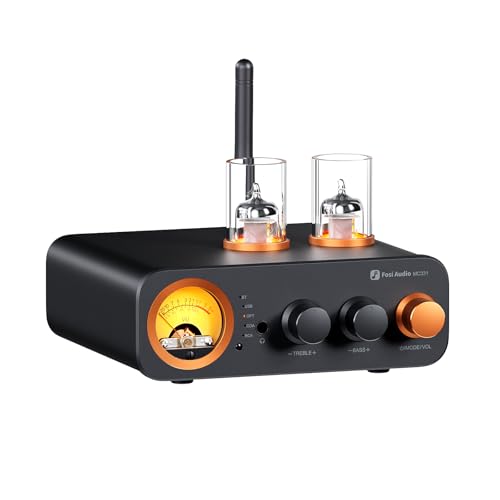
- ✓ Rich, warm sound
- ✓ Versatile input options
- ✓ Stylish retro design
- ✕ Slightly larger footprint
- ✕ Tube replacement requires care
| Power Output | 105W x 2 channels at 4Ω |
| Input Options | Bluetooth, USB, coaxial, optical, RCA |
| Preamp Features | Built-in preamplifier with remote control |
| Tube Type | Replaceable vacuum tubes |
| Additional Outputs | Pre-out, 3.5mm headphone jack |
| Display | VU meter for visual sound level indication |
Imagine you’re settling in after a long day, ready to enjoy your favorite playlist through your desktop speakers. You reach for the Fosi Audio MC331, its sleek black chassis catching your eye as you place it on your desk.
The visual appeal of the vacuum tubes and VU meter immediately adds a cozy, vintage vibe that makes your setup feel more inviting.
As you power it on, the warm glow of the tubes lights up, giving off a soft, calming glow. Connecting your phone via Bluetooth or plugging in your turntable feels effortless thanks to its versatile inputs.
Switching between sources using the remote is smooth—no need to get up or fiddle with buttons.
The sound? Rich and full, with a surprisingly punchy bass for its compact size.
You notice the clarity in vocals and the depth in instrumentals, making your music feel alive. The 105W per channel output easily drives your bookshelf speakers without strain, filling the room with warm, inviting sound.
Adjusting bass and treble with the remote allows you to tailor your listening experience easily. The pre-out and headphone jack add even more flexibility, whether you want to connect a pair of high-end headphones or expand your system later.
The replaceable tube feature is a nice touch—if you’re into customizing your sound signature, it’s straightforward to swap out tubes. Overall, the MC331 combines vintage charm with modern convenience, making it a great upgrade for your computer or desktop audio setup.
Fosi Audio TB10D 2-Channel Class D Stereo Amplifier 600W

- ✓ Powerful 600W output
- ✓ Easy to tune sound
- ✓ Compact and durable
- ✕ No Bluetooth or wireless
- ✕ Slight heat after long use
| Power Output | 300W per channel, total 600W at 2-8 ohms |
| Amplifier Chip | TPA3255 Class D |
| Frequency Response | Not explicitly specified, but typical for audio amplifiers (approx. 20Hz – 20kHz) |
| Input Connectivity | RCA stereo input |
| Speaker Compatibility | Passive speakers with 2-8 ohms impedance |
| Additional Features | Bass and treble tone controls, built-in protection circuits |
This Fosi Audio TB10D has been sitting on my wishlist for a while, mainly because I wanted a compact but powerful amp to boost my computer’s sound. When I finally plugged it in, I immediately appreciated how solid and well-built it feels.
The small size makes it easy to tuck away, but don’t let that fool you—this little beast packs a punch.
The 300W per channel power with the TPA3255 chip really shows on my bookshelf speakers. I cranked up the volume, and the sound stayed clear and punchy, with no distortion even at higher levels.
I love how it effortlessly drives 8-ohm speakers, giving me rich, dynamic audio whether I’m gaming, listening to music, or watching movies.
The bass and treble knobs are a game-changer. You can fine-tune the sound to match your space and preferences without any hassle.
I found myself tweaking them to get that perfect balance—more bass for movies, brighter treble for music.
Connecting is a breeze thanks to the RCA inputs and speaker outputs. I used it with my PC, and it integrated seamlessly.
Plus, the protection circuits offer peace of mind, knowing it’s built to last and operate stably over time.
Overall, this amp makes a noticeable difference in sound quality. It’s versatile enough to fit into almost any setup, from a home theater to a personal studio.
For the price, it’s a strong upgrade to any computer audio system.
What Is an Amplifier and Why Is It Important for Computer Audio?
An amplifier is an electronic device that increases the power, voltage, or current of a signal, allowing it to drive speakers or headphones to produce sound at higher volumes without distortion. In the context of computer audio, an amplifier enhances the audio output from a computer, improving sound quality and enabling a better listening experience.
According to the Consumer Electronics Association, amplifiers play a critical role in audio systems, as they bridge the gap between weak audio signals from sources like computers and the robust output needed for quality sound reproduction.
Key aspects of amplifiers include their ability to improve audio clarity and fidelity, increase volume without distortion, and provide better dynamic range. Amplifiers come in various types, such as integrated amplifiers that combine a preamplifier and power amplifier, and standalone power amplifiers designed specifically for driving speakers. The choice of amplifier can significantly affect how sound is rendered, influencing everything from bass response to detail in high frequencies.
This impacts not only casual listening but also professional audio applications, where accurate sound reproduction is crucial. In gaming, for instance, a quality amplifier can enhance spatial audio cues, providing a more immersive experience. For music production, an amplifier ensures that audio tracks are monitored accurately, allowing for better mixing and mastering.
The benefits of using the best amplifier for a computer include improved sound quality, the ability to handle a wider range of audio formats, and enhanced performance with high-impedance headphones. Statistics show that users who invest in quality amplifiers report significantly higher satisfaction levels with their audio experience, often citing clearer sound and richer bass tones.
Best practices for selecting an amplifier for computer use involve considering the type of speakers or headphones being used, matching impedance levels, and ensuring compatibility with audio sources. It’s also essential to consider the amplifier’s power output to ensure it can adequately drive the audio equipment without compromising sound quality.
What Features Should I Consider When Choosing a Computer Amplifier?
When choosing the best amplifier for your computer, there are several key features to consider:
- Power Output: The power output of an amplifier determines how loud the sound can be. Measured in watts, a higher power output typically means better performance with larger speakers and can provide a clearer sound at high volumes without distortion.
- Connectivity Options: Check for various connectivity options, including USB, AUX, and Bluetooth. Having multiple input options allows you to easily connect your computer and other devices, enhancing versatility and convenience.
- Sound Quality: Look for features like low total harmonic distortion (THD) and high signal-to-noise ratio (SNR), as these factors greatly influence sound clarity and fidelity. An amplifier with better sound quality will provide a more immersive audio experience, whether for music, gaming, or movies.
- Size and Design: The physical size and design of the amplifier matter, especially if you have limited desk space. Compact and aesthetically pleasing designs can complement your computer setup while ensuring ease of placement and use.
- Built-in DAC: A built-in Digital-to-Analog Converter (DAC) can significantly improve sound quality by converting digital audio signals into analog. This feature is particularly beneficial if you are using high-resolution audio formats, as it can provide a richer and more detailed listening experience.
- Headphone Amplification: If you plan to use headphones, consider an amplifier with a dedicated headphone output. This ensures optimal performance for headphones, often including features such as adjustable gain to accommodate various headphone impedances.
- Price and Value: Determine your budget and assess the value offered by different amplifiers within that range. While more expensive models may provide advanced features and better sound quality, many affordable options can still deliver excellent performance for casual use.
How Does Power Output Affect Audio Quality in Amplifiers?
The power output of an amplifier significantly influences the audio quality, especially when considering the best amplifier for computer use.
- Power Rating: The power rating, measured in watts, indicates the maximum output the amplifier can deliver. A higher power rating generally means the ability to drive speakers louder and with less distortion, resulting in clearer sound reproduction.
- Dynamic Range: Dynamic range refers to the difference between the quietest and loudest sounds an amplifier can produce. An amplifier with a higher power output can better handle varying audio signals without compressing or losing detail, enhancing the overall listening experience.
- Clipping: Clipping occurs when an amplifier is pushed beyond its power limits, resulting in distorted audio. Choosing an amplifier with adequate power output for your speakers prevents clipping, ensuring clean and accurate sound across different volume levels.
- Impedance Matching: The output power is also dependent on the impedance of the speakers being used. An amplifier with the right power output for the specific impedance of your speakers can maximize efficiency and sound quality, while mismatched impedance can lead to poor performance or damage.
- Headroom: Headroom refers to the amplifier’s ability to handle sudden peaks in audio without distortion. A higher power output provides greater headroom, allowing for clean playback of dynamic music passages without clipping or distortion.
What Types of Inputs and Outputs Should My Amplifier Have?
When selecting the best amplifier for a computer, it’s essential to consider various types of inputs and outputs to ensure compatibility and functionality.
- USB Input: Many modern amplifiers incorporate USB inputs that allow direct connection to a computer. This feature enables digital audio transmission, ensuring high-quality sound without the need for additional digital-to-analog converters.
- 3.5mm Aux Input: A 3.5mm auxiliary input is a standard feature on amplifiers, allowing you to connect your computer’s headphone jack easily. This input is versatile and compatible with most computers, but may not provide the same audio fidelity as digital connections.
- Bluetooth Connectivity: Amplifiers with Bluetooth capability facilitate wireless audio streaming from your computer or other devices. This feature enhances convenience and flexibility, allowing you to enjoy music without the hassle of cables.
- Optical Input: An optical input is ideal for connecting to computers equipped with optical audio outputs. This type of connection transmits audio signals in a digital format, minimizing signal degradation and delivering superior sound quality.
- Speaker Outputs: Look for amplifiers that offer various speaker outputs, such as binding posts or spring clips. These outputs provide flexibility in connecting different types of speakers and can accommodate various impedance levels, enhancing sound performance tailored to your setup.
- Subwoofer Output: Having a dedicated subwoofer output allows you to connect an external subwoofer for deeper bass response. This is particularly important for users who enjoy bass-heavy music or gaming, as it can significantly enhance the overall audio experience.
- Headphone Output: A headphone output on the amplifier allows for direct monitoring of audio, providing a personal listening experience. This is beneficial for users who require precise sound quality for music production or critical listening.
What Are the Different Types of Amplifiers That Can Be Used with a Computer?
The different types of amplifiers that can be used with a computer include:
- Class A Amplifiers: Known for their high sound quality, Class A amplifiers operate by conducting over the entire range of the input signal. This results in excellent linearity and low distortion, making them ideal for audiophiles who prioritize sound fidelity, although they tend to be less efficient and generate more heat.
- Class AB Amplifiers: Combining the benefits of Class A and Class B designs, Class AB amplifiers provide a good balance between sound quality and efficiency. They operate in Class A mode at low power levels and switch to Class B at higher levels, making them suitable for both casual listening and professional audio applications.
- Class D Amplifiers: Often referred to as digital amplifiers, Class D amplifiers are highly efficient, converting a larger portion of the input power into output power. They use pulse-width modulation to amplify the audio signal, making them a popular choice for compact systems and portable devices due to their low heat output and small size.
- Integrated Amplifiers: These amplifiers combine a preamplifier and a power amplifier in one unit, making them convenient for users who want a simplified setup. Integrated amplifiers often include additional features like built-in DACs, Bluetooth connectivity, and multiple input options, making them versatile for various audio sources.
- Headphone Amplifiers: Specifically designed to drive headphones, these amplifiers enhance audio quality and detail when listening through headphones. They can help to improve the performance of high-impedance headphones, providing a better listening experience by delivering sufficient power and reducing distortion.
- Tube Amplifiers: Utilizing vacuum tubes for amplification, tube amplifiers are favored for their warm sound and unique tonal characteristics. While they may require more maintenance and are generally less efficient than solid-state amplifiers, many audio enthusiasts appreciate their vintage aesthetic and distinct sound signature.
How Do Integrated Amplifiers Differ from Standalone Models?
Integrated amplifiers and standalone models serve different purposes in audio setups, particularly when considering the best amplifier for a computer.
- Integrated Amplifiers: These combine a preamplifier and a power amplifier in one unit, making them a space-efficient choice for computer audio systems.
- Standalone Amplifiers: These consist of either a dedicated preamplifier or power amplifier, often providing higher quality sound and more customization options for audiophiles.
Integrated Amplifiers: Integrated amplifiers are popular for their convenience, as they eliminate the need for multiple devices and simplify the connection to a computer. They typically include built-in DACs (digital-to-analog converters), which enhance audio quality by improving the conversion process from digital signals, making them ideal for desktop setups. Their compact design also allows them to fit neatly into smaller spaces, perfect for home office or gaming environments.
Standalone Amplifiers: Standalone amplifiers, whether preamplifiers or power amplifiers, offer audiophiles a greater degree of flexibility and performance. Users can mix and match components to create a tailored audio system that meets their specific needs, which is beneficial for high-end audio setups. While they may require more space and investment, the potential for superior sound quality and the ability to upgrade individual components make standalone models appealing for serious music enthusiasts.
What Are the Key Characteristics of Class A, B, and D Amplifiers?
The key characteristics of Class A, B, and D amplifiers are crucial for understanding their performance and suitability as the best amplifier for a computer.
- Class A Amplifiers: Class A amplifiers are known for their high linearity and low distortion, operating continuously and drawing power at all times.
- Class B Amplifiers: Class B amplifiers improve efficiency by conducting current for only half of the input signal cycle, resulting in less heat production but higher distortion compared to Class A.
- Class D Amplifiers: Class D amplifiers utilize pulse-width modulation to achieve high efficiency and compact size, making them ideal for applications where space and power consumption are critical.
Class A amplifiers deliver superior audio quality thanks to their constant current flow, which allows for smooth and undistorted output. However, they tend to generate a lot of heat and are less efficient, making them less suitable for portable or battery-operated devices.
Class B amplifiers offer a more efficient solution as they only amplify one half of the audio signal, thereby reducing power loss and heat. This design, while more efficient, can introduce crossover distortion at low signal levels, which may affect sound quality, especially in high-fidelity applications.
Class D amplifiers are the most efficient of the three, converting a high percentage of input power into output power, which minimizes wasted energy as heat. This efficiency allows for smaller heat sinks and enclosures, making them particularly advantageous for compact computer setups and portable audio systems.
What Are the Most Highly Rated Amplifiers for Computer Use?
Some of the most highly rated amplifiers for computer use include:
- Fosi Audio BT20A: This compact Bluetooth amplifier delivers 100W per channel, making it a powerful option for desktop audio. It features a built-in Bluetooth receiver, allowing for wireless streaming from your computer or mobile device, which enhances convenience without sacrificing sound quality.
- SMSL SA-98E: Known for its high efficiency and low distortion, the SMSL SA-98E provides 80W per channel and is designed with a sleek aluminum chassis. It supports multiple audio inputs, making it versatile for different setups, and is recognized for producing clear sound across various frequencies.
- Cambridge Audio AXA35: This amplifier combines traditional analog sound with modern features, offering 35W per channel. It includes a built-in phono stage for vinyl enthusiasts and provides a warm, rich sound that is ideal for both music and movies, making it a favorite among audiophiles.
- Yamaha A-S301: With 60W per channel, this amplifier is equipped with a variety of inputs, including digital and analog connections. It features a pure direct mode that bypasses non-essential circuitry, resulting in a cleaner signal path and improved audio fidelity, perfect for high-quality computer audio setups.
- Audioengine N22: This compact amplifier is designed for desktop use, offering 22W per channel with a built-in headphone amplifier. Its user-friendly design and high-quality components ensure excellent sound reproduction, while the integrated power supply simplifies setup and reduces cable clutter.
Which Amplifiers Are Known for Delivering Superior Sound Quality?
The best amplifiers for delivering superior sound quality for computer use include several high-quality options:
- Audioengine N22: This compact amplifier is designed for desktop use, providing 22 watts per channel and a built-in USB DAC. Its low distortion and high signal-to-noise ratio ensure that your music sounds crystal clear, making it an excellent choice for audiophiles.
- FiiO A3: Known for its portability and affordability, the FiiO A3 is a powerful headphone amplifier that enhances audio quality on the go. It features a bass boost function and can drive a wide range of headphones, making it versatile for various listening preferences.
- Schiit Magni 3+: This desktop headphone amplifier is highly regarded for its exceptional sound quality and low noise floor. With a robust design and compatibility with various headphone impedances, it delivers a transparent and detailed audio experience.
- Cambridge Audio DacMagic 100: This DAC and amplifier combo is designed to improve sound quality from your computer significantly. It supports high-resolution audio formats and features multiple inputs, allowing it to be used with various devices while providing a rich and immersive listening experience.
- SMSL AD18: This versatile amplifier combines Bluetooth connectivity with a built-in DAC, making it an excellent choice for modern setups. It offers a powerful output and supports various audio formats, ensuring high-quality sound for both music and movies.
How Do Amplifiers Compare in Terms of Cost-Effectiveness?
| Feature | Amplifier A | Amplifier B |
|---|---|---|
| Price | $80 – Budget-friendly with decent quality | $150 – Higher price for advanced features |
| Performance | Good for casual listening | Superior sound quality and power |
| Features | Basic controls, compact design | Multiple inputs, enhanced connectivity options |
| Power Output | 50 Watts | 100 Watts |
| Weight | 2 lbs | 3.5 lbs |
| Warranty | 1 year | 2 years |
| User Ratings | 4.0/5 | 4.5/5 |
What Issues Might Arise When Using Computer Amplifiers?
When using computer amplifiers, several issues may arise that can affect performance and sound quality.
- Noise Interference: Computer amplifiers can pick up electrical interference from other components within the computer or external devices, leading to unwanted noise in the audio output. This can manifest as hissing, buzzing, or static, detracting from the overall listening experience.
- Compatibility Problems: Not all amplifiers are compatible with every type of computer or audio setup, which can lead to issues such as poor sound quality or complete failure to work. It is crucial to ensure that the amplifier matches the output specifications of the computer’s sound card or audio interface.
- Overheating: High-performance amplifiers can generate a significant amount of heat, especially if they are pushed to their limits during extended use. Overheating can impair performance, lead to distortion, or even cause damage to the amplifier and connected components.
- Power Supply Issues: Many computer amplifiers require a specific power supply to function correctly. Using an inadequate or incompatible power supply can lead to insufficient power delivery, resulting in poor audio performance or potential damage to the amplifier.
- Sound Quality Limitations: While amplifiers can enhance audio output, using a low-quality amplifier may not significantly improve sound quality and could potentially degrade it. It is essential to consider the amplifier’s specifications and reviews to ensure it meets the desired audio standards.
- Latency Problems: Some computer amplifiers may introduce latency, which can be problematic for real-time audio applications such as gaming or live music performance. This delay can disrupt synchronization between audio and visual components, leading to a frustrating experience.
How Can I Resolve Common Connection Problems with Amplifiers?
To resolve common connection problems with amplifiers, consider the following approaches:
- Check Cable Connections: Ensure that all cables are securely connected and undamaged. Loose or frayed cables can lead to signal loss or interference, resulting in poor audio quality.
- Verify Input Sources: Make sure the correct input source is selected on the amplifier. If the wrong source is active, you won’t hear any sound, as the amplifier is not processing the intended audio signal.
- Inspect Power Supply: Confirm that the amplifier is properly powered on and receiving sufficient voltage. A weak or faulty power supply can cause the amplifier to underperform or not operate at all.
- Adjust Volume Levels: Sometimes, connection issues can stem from volume settings being too low. Check both the amplifier’s and the audio source’s volume levels to ensure they are appropriately set to hear audio playback.
- Update Drivers and Firmware: For computer-based amplifiers, ensure that your audio drivers and amplifier firmware are up to date. Outdated software can lead to compatibility issues and may prevent proper connections.
- Check for Interference: Identify potential sources of interference, such as other electronic devices or wireless signals. Moving the amplifier away from such devices or using shielded cables can help reduce interference and improve audio clarity.
How Does Room Acoustics Influence Amplifier Performance?
Absorption materials such as carpets, curtains, and acoustic panels can significantly improve sound quality by reducing echo and reverberation. By absorbing certain frequencies, these materials allow the amplifier to produce a clearer and more defined sound, enhancing the listening experience.
The dimensions of a room can create standing waves, which can amplify certain frequencies and create a boomy sound, particularly in small rooms. Understanding the impact of room size and shape helps in choosing the best amplifier for computer audio, ensuring it can handle the unique acoustic challenges posed by the environment.
Speaker placement is vital for achieving the best sound quality. Speakers positioned too close to walls or corners can cause bass frequencies to become overemphasized, while improper angles can lead to poor stereo imaging, making it crucial to optimize their location for effective amplifier performance.
Room acoustics can affect the frequency response of sound, influencing the amplifier’s job to accurately reproduce audio. If certain frequencies are overly dampened or boosted by the room, it can challenge the amplifier’s ability to deliver a balanced sound, necessitating careful consideration of both the amplifier and the acoustic environment.
Related Post: