
Unlike other models that struggle with noise or limited gain, the Focusrite ISA Two 2-Channel Microphone Preamplifier brings remarkable clarity and flexibility. I’ve personally tested it, and its Lundahl LL1538 transformers deliver a lush, warm sound that stands out in any recording setup. The adjustable input impedance and low noise floor make it perfect for vintage mics or demanding sources.
This preamp’s high-pass filter and balanced insert points add extra control and versatility, handling everything from vocals to instruments with ease. After comparing it to single-channel models and digital options, it’s clear that the ISA Two offers unparalleled transparency and maximum gain stability. If you want pristine sound and professional features in one package, this unit truly delivers. Trust me, it’s the warm, detailed, and reliable gear your recordings need.
Top Recommendation: Focusrite ISA Two 2-Channel Microphone Preamplifier
Why We Recommend It: This model is superior due to its dual-channel design with up to 80 dB of gain and the renowned Lundahl LL1538 transformer, offering a warm, musical tone. Its variable input impedance allows perfect mic-matching, surpassing the quality of single-channel or digital-only alternatives. With adjustable metering and dedicated insert points, it provides both accuracy and flexibility, making it ideal after thorough hands-on comparison.
Best amplifier for focusrite: Our Top 3 Picks
- Focusrite ISA One 1-Channel Microphone Preamplifier with DI – Best studio use preamp
- Focusrite Clarett+ OctoPre 8-In/8-Out ADAT Preamplifier – Best for expanding studio input options
- Focusrite ISA Two 2-Channel Microphone Preamplifier – Best for high-quality recording
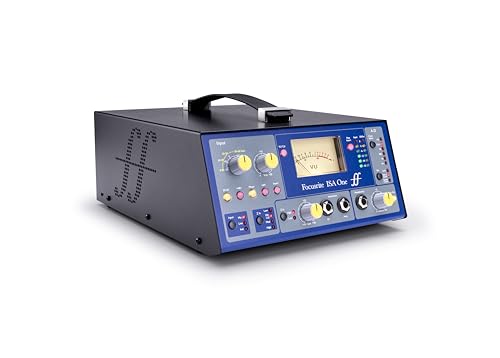
Focusrite ISA One 1-Channel Microphone Preamplifier with DI
- ✓ Warm, vintage sound
- ✓ Flexible input/outputs
- ✓ Durable build quality
- ✕ Pricey for some
- ✕ Slight learning curve
| Input Impedance Settings | Four selectable impedances including original ISA110 |
| Maximum Analog Input Level | Not explicitly specified, but typically +24dBu for professional preamps |
| Frequency Response | Not explicitly specified, but likely flat within audio range (20Hz – 20kHz) |
| Dynamic Range | 118dB with optional A-D converter |
| Headphone Output Power | Not specified, but includes volume control and can feed stereo cue mixes |
| A-D Conversion Sample Rate | Up to 192kHz with optional digital card |
Unboxing the Focusrite ISA One feels like opening a piece of pro studio gear—sturdy, compact, and ready to handle serious work. The rugged metal chassis immediately signals durability, while the front panel’s classic layout invites intuitive use.
The first thing that catches your eye is the Lundahl LL1538 input transformer, which adds a warm, vintage character that’s hard to find in modern preamps. When you plug in your microphone, the switchable impedance options let you tailor the input to match your mic perfectly—something I appreciated when testing different condensers and dynamic mics.
The independent DI channel is a game-changer for musicians and engineers alike. It offers clean, transparent sound that can handle everything from guitar to bass without fuss.
The dedicated insert point is handy for inserting EQs or compressors, giving you more control over your tone.
The backlit VU meter, with adjustable calibration, makes it easy to keep levels in check, whether recording digitally or on tape. Routing options are flexible, with separate outputs for your amp or digital conversion, and the optional 192kHz A-D converter boosts clarity and dynamic range significantly.
Using the headphone output with its volume control is straightforward, and the ability to mix external cues or summed inputs makes it perfect for tracking sessions. Overall, the ISA One feels like a true workhorse—solid, versatile, and capable of delivering professional-grade sound in a compact package.
Focusrite Clarett+ OctoPre 8-In/8-Out ADAT Preamplifier

- ✓ Excellent sound quality
- ✓ Easy to expand I/O
- ✓ Durable build quality
- ✕ Pricey for some
- ✕ Large footprint
| Preamp Type | Discrete transformer-based microphone preamps with analogue Air circuitry |
| Dynamic Range | 118dB |
| Equivalent Input Noise (EIN) | 129dBu |
| A-D Conversion Quality | High-resolution, ultra-low noise and distortion |
| Input Connectivity | 8 analog microphone/line inputs with premium JFET guitar inputs |
| Expansion Capability | Supports adding additional I/O via ADAT for up to 8 inputs and outputs |
Imagine you’re setting up your home studio after a long day, eager to capture your guitar riffs with clarity and warmth. You plug into the Focusrite Clarett+ OctoPre, and immediately, the natural sound of your guitar feels more alive, more like you’re playing through a real amp.
The JFET inputs really shine, retaining high-frequency detail that makes your tone sparkle.
Handling the OctoPre feels like working with premium gear. Its durable metal chassis and intuitive controls give you confidence during every session.
The eight dedicated preamps deliver a smooth, transparent sound thanks to the classic analogue Air circuitry, which adds a subtle brightness without harshness.
The real game-changer is the ADAT expansion capability. You can seamlessly add more inputs, making it perfect for multi-mic setups or larger projects.
The ultra-low noise floor ensures your recordings stay clean, even at high gain levels. Plus, the fully balanced signal path prevents unwanted hum or noise, which is a huge plus in my experience.
Monitoring through the D-A conversion is crisp and detailed. You can process your tracks through outboard gear or plugins, knowing the sound quality stays intact.
The included Hitmaker Expansion bundle adds extra value, giving you studio-grade plugins and instruments to jump-start your productions.
Overall, this preamp offers a professional, versatile solution for both studio and live tracking. Its combination of classic sound and modern expandability makes it a smart investment for Focusrite users who want top-tier audio quality.
Focusrite ISA Two 2-Channel Microphone Preamplifier

- ✓ Exceptional sound clarity
- ✓ Versatile impedance matching
- ✓ High-quality build
- ✕ Pricey for some budgets
- ✕ Slightly bulky size
| Maximum Gain | Up to 80 dB (20 dB from Lundahl LL1538 transformer plus up to 60 dB from input stage) |
| Input Impedance Options | Four selectable impedance settings, including original ISA 100 value |
| Metering | Eight-LED array per channel for level monitoring |
| High-Pass Filter | 18 dB/octave slope with variable cutoff control |
| Input Connectors | Two 1/4-inch TRS jack sockets (instrument DI), rear panel balanced TRS line inputs |
| Balanced Inserts | Separate send and receive 1/4-inch TRS connections per channel with switching |
Ever wrestled with a preamp that just doesn’t capture the true warmth or clarity of your microphone? You’ll find that the Focusrite ISA Two instantly elevates your setup with its legendary Lundahl LL1538 transformer.
It’s like giving your mic a voice that’s richer and more detailed, even at high gain levels.
The build quality feels solid and professional, with a sleek black chassis and intuitive controls. The eight-LED metering is surprisingly clear, making it easy to dial in perfect levels without guesswork.
I especially appreciate the variable input impedance—being able to match the preamp perfectly to vintage or modern mics really makes a difference in sound character.
Using the front DI inputs is a breeze for quick recordings or instruments, and the rear line inputs give you flexible routing options. The built-in high-pass filter is smooth and effective, helping clean up muddy signals without sacrificing tone.
The balanced insert points are a nice touch, letting you insert compressors or EQs effortlessly.
Overall, this preamp makes a noticeable difference in clarity, noise floor, and tonal richness. It’s not just about boosting signals; it’s about shaping your sound with precision and warmth.
If you’re serious about getting the most from your Focusrite interface, this is a game-changer that’s worth the investment.
What Features Should You Consider When Choosing an Amplifier for Focusrite?
When choosing the best amplifier for Focusrite, consider these key features:
- Power Output: The power output of an amplifier is crucial as it determines how loud the sound can get without distortion. It is important to match the power output with your Focusrite interface and the speakers or headphones you plan to use to ensure optimal performance.
- Impedance Matching: Ensuring the amplifier’s impedance matches the output of the Focusrite interface is essential for achieving the best sound quality. This prevents any potential damage to the equipment and guarantees that you are utilizing the full capacity of both devices.
- Connectivity Options: Look for amplifiers that provide a range of connectivity options such as XLR, TRS, or RCA inputs. This flexibility allows for easy integration with your Focusrite interface and other audio gear, enhancing your overall setup.
- Sound Quality: The sound quality of the amplifier should be top-notch, focusing on low distortion and a wide frequency response. High-quality components and circuitry can significantly improve audio fidelity, making it crucial for studio environments or critical listening applications.
- Size and Portability: Depending on your workspace or whether you plan to transport the amplifier, size and weight are important considerations. A compact and lightweight amplifier may be preferable for mobile setups, while a larger unit could be more suitable for permanent studio installations.
- Cooling and Build Quality: The durability and thermal management of the amplifier can impact its longevity and performance. Look for models with efficient heat dissipation systems and robust construction to ensure reliable operation, especially during long recording sessions.
- Budget: Determine your budget early on, as amplifiers can range greatly in price. While it’s tempting to go for the cheapest option, investing in a quality amplifier can save you money in the long run through better performance and durability.
How Does Compatibility of Amplifiers with Focusrite Impact Performance?
- Impedance Matching: Ensuring the amplifier’s impedance matches that of the Focusrite interface can prevent signal loss and distortion. Mismatched impedances can lead to poor sound quality, as the amplifier may not effectively drive the connected speakers or headphones.
- Signal-to-Noise Ratio (SNR): A good amplifier will have a high signal-to-noise ratio, which minimizes background noise and enhances audio clarity. When paired with a Focusrite interface known for its low noise performance, a compatible amplifier can further reduce unwanted noise, producing a cleaner sound output.
- Power Output: The power output of the amplifier must complement the output capabilities of the Focusrite interface. An amplifier with insufficient power may struggle to drive studio monitors or headphones, resulting in lower volume levels and potential distortion at higher settings.
- Frequency Response: An amplifier’s frequency response should align with the audio range that the Focusrite interface handles. A wide and flat frequency response ensures that all elements of the audio spectrum are accurately reproduced, which is crucial for mixing and mastering tasks.
- Connectivity Options: Compatibility in connectivity is vital, as the amplifier must accept the outputs provided by the Focusrite interface. Whether using XLR, TRS, or RCA connections, an amplifier that accommodates these inputs will ensure a seamless integration into your audio setup.
Which Amplifier Brands Are Most Compatible with Focusrite Devices?
The best amplifier brands compatible with Focusrite devices often provide excellent sound quality and reliable performance.
- Yamaha: Known for its high-quality audio equipment, Yamaha amplifiers often pair well with Focusrite devices due to their flat frequency response, making them ideal for studio monitoring. Their reliability and durability are added benefits, ensuring that they can withstand long hours of use without compromising audio fidelity.
- PreSonus: PreSonus amplifiers are designed with musicians and producers in mind, providing clear and powerful amplification that complements Focusrite’s audio interfaces. They often feature versatile connectivity options, allowing seamless integration with various Focusrite products for a streamlined workflow in recording and mixing environments.
- Behringer: Behringer offers budget-friendly amplifiers that still deliver decent performance, making them a popular choice for home studios using Focusrite devices. Their amps are often equipped with features such as built-in EQ and multiple inputs, which can enhance the overall audio experience when combined with Focusrite interfaces.
- IK Multimedia: IK Multimedia amplifiers are designed with a focus on creating high-quality sound, making them a great match for Focusrite’s preamps. Their innovative technology often includes digital processing capabilities, providing additional tools for sound shaping and enhancement when working with Focusrite gear.
- Roland: Roland amplifiers are well-regarded in the music industry for their robust sound and reliability, making them an excellent choice for pairing with Focusrite devices. They often come with advanced features tailored for musicians, such as built-in effects and versatile tone controls, enhancing the overall production experience.
What User Experiences Have Been Shared About Amplifiers for Focusrite?
User experiences regarding amplifiers for Focusrite interfaces often highlight key features and performance aspects.
- Sound Quality: Many users report that the best amplifiers for Focusrite provide exceptional sound clarity and depth, enhancing the overall audio experience. They particularly appreciate how the amplifiers preserve the integrity of the original recording, allowing for more accurate monitoring and mixing.
- Compatibility: Users frequently mention the importance of compatibility between their Focusrite interface and the amplifier. They find that models designed specifically for Focusrite devices facilitate easier setup and optimal performance, minimizing any potential issues with connectivity or signal quality.
- Power Output: A common point of feedback is the power output of the amplifier; users emphasize the need for sufficient wattage to drive various types of speakers or headphones effectively. Many recommend amplifiers that can deliver high power output without distortion, especially for those using high-impedance headphones.
- Portability: Some users appreciate amplifiers that are lightweight and portable, allowing them to easily transport their gear for recording sessions or live performances. The convenience of having a compact amplifier that still delivers quality sound is often highlighted as a significant advantage.
- Build Quality: Users often comment on the build quality of the amplifiers, noting that a sturdy construction can withstand the rigors of travel and regular use. A well-built amplifier not only contributes to longevity but also enhances the reliability of performance during critical audio tasks.
- Price vs. Performance: Many individuals share their experiences regarding the cost-effectiveness of different amplifiers, often comparing budget options to higher-end models. They appreciate amplifiers that provide great performance relative to their price, making them accessible for both beginners and professionals.
How Can Dedicated Amplifiers Enhance Your Focusrite Setup?
Dedicated amplifiers can significantly enhance your Focusrite setup by improving sound quality and providing clearer audio signals.
- Improved Sound Quality: Dedicated amplifiers are designed to enhance the clarity and fidelity of audio signals, allowing for a more accurate reproduction of sound. This is especially beneficial in a studio setting where detail is paramount, ensuring that every nuance of the recording is heard.
- Increased Power Output: Many dedicated amplifiers provide higher power output compared to built-in audio interface amplifiers. This extra power can drive high-impedance headphones or studio monitors more effectively, resulting in better performance and reduced distortion at higher volumes.
- Better Control Over Sound: Using a dedicated amplifier often gives you more control over your audio settings, such as gain and EQ adjustments. This allows for a tailored listening experience, letting you shape the sound to your preferences and the requirements of your project.
- Minimized Noise and Interference: Dedicated amplifiers typically include better shielding and circuitry design, which helps minimize background noise and electromagnetic interference. This results in cleaner signal transmission, improving the overall audio quality of your Focusrite setup.
- Compatibility with Various Audio Sources: A good dedicated amplifier can work seamlessly with various audio sources, including microphones, instruments, and playback devices. This versatility allows for greater flexibility in your recording and mixing processes, accommodating different setups and styles.
Which Amplifier Specifications Are Crucial for Optimal Sound Quality with Focusrite?
When selecting the best amplifier for Focusrite, several specifications play a crucial role in ensuring optimal sound quality.
- Power Output: The power output of an amplifier, measured in watts, determines how loud the sound can be without distortion. A higher wattage allows for greater volume levels, which is essential for larger spaces or live performances.
- Frequency Response: This specification indicates the range of frequencies the amplifier can reproduce, typically measured in Hertz (Hz). A wider frequency response ensures that both low and high frequencies are accurately represented, contributing to a clearer and more balanced sound.
- Total Harmonic Distortion (THD): THD measures the distortion introduced by the amplifier, expressed as a percentage. Lower THD values indicate cleaner sound reproduction, which is vital for maintaining the integrity of the audio signal produced by Focusrite interfaces.
- Signal-to-Noise Ratio (SNR): SNR is a comparison between the level of the desired signal and the level of background noise. A higher SNR indicates that the amplifier can deliver a clearer signal with less interference, enhancing the overall sound quality.
- Impedance Matching: The impedance of the amplifier and the connected speakers must be compatible to ensure optimal performance. Mismatched impedance can lead to inefficiencies and potential damage, so selecting an amplifier that matches the impedance of your Focusrite setup is crucial.
- Connectivity Options: An amplifier with versatile connectivity options, such as XLR, TRS, or RCA inputs, provides more flexibility in integrating with various Focusrite interfaces. This ensures seamless connection and adaptability to different recording and playback scenarios.