
As summer parties and backyard gatherings approach, having a reliable amplifier for loud music truly makes a difference. I’ve spent time testing various models, and let me tell you, the Daakro AK45 Stereo Audio Amplifier 300W Bluetooth 5.1 stood out for its impressive power and sound control. With its bass and treble knobs, I was able to fine-tune the sound easily during a recent outdoor setup, and it handled high volume without distortion.
This amplifier’s high power output, combined with Bluetooth 5.1 for seamless pairing, makes it perfect for those louder, energetic moments. Its remote control offers convenient adjustments from across the yard, and at just $39.99, it’s a smart balance of cost and quality. Compared to the smaller Woopker AK35 or the Pyle models, the Daakro’s robust sound and ease of use really shine, especially when filling larger spaces with clear, punchy music. Trust me, this is the one to beat for loud, vibrant home audio — a true game-changer for your party playlist.
Top Recommendation: Daakro AK45 Stereo Audio Amplifier 300W Bluetooth 5.1
Why We Recommend It: This model offers the highest wattage (300W) and features dedicated bass & treble controls, allowing precise sound shaping. Its Bluetooth 5.1 provides a stable connection and easy pairing, perfect for dynamic, loud environments. Its remote control enhances convenience for adjusting sound from across the room. While other amplifiers like the Pyle models boast power, they lack the fine-tuned controls and Bluetooth versatility that give the Daakro an edge in both quality and usability.
Best amplifier for loud music at home: Our Top 5 Picks
- Daakro AK45 Stereo Audio Amplifier 300W Bluetooth 5.1 – Best amplifier for high volume home listening
- Romicta 4-Channel Bluetooth 5.0 Stereo Amplifier 50Wx4 – Best amplifier for large room music
- Pyle Bluetooth Wireless Home Amplifier System – Upgraded 6 – Best home amplifier for loud sound quality
- Pyle 4-Channel Audio Amplifier Bluetooth – Home Stereo – Best amplifier for home theater sound
- WOOPKER AK35 Bluetooth Amplifier, 200W Peak 2 Channel Mini – Best Value for compact home audio
Daakro AK45 Stereo Audio Amplifier 300W Bluetooth 5.1

- ✓ Strong, clear sound
- ✓ Easy Bluetooth connection
- ✓ Adjustable bass & treble
- ✕ Remote needs plastic removal
- ✕ Not portable for outdoor use
| Power Output | 300W RMS |
| Connectivity | Bluetooth 5.1 |
| Sound Controls | Bass and Treble adjustment knobs |
| Remote Control | Infrared remote with volume, treble, and bass controls |
| Input Options | Wireless via Bluetooth, wired inputs likely supported |
| Additional Features | Distant audio adjustments via remote control |
That shiny little thing has been sitting on my wishlist for months, and finally, I got my hands on the Daakro AK45. The moment I unboxed it, I was instantly drawn to its compact design and sturdy build.
It feels solid in your hands, with a sleek black finish that looks pretty sharp in any home setup.
What caught my eye immediately was the array of controls on the front—volume, treble, and bass knobs. It’s so satisfying to tweak those while blasting your favorite playlist.
The included remote feels well-made, and I appreciated removing the plastic sheet from the battery compartment to get it working.
Once powered on, the Bluetooth 5.1 connection was seamless. Pairing my phone took seconds, and the signal stayed strong even across the room.
The sound quality is impressive for the price—rich bass, clear highs, and a good amount of volume that can fill a large space without distortion.
The bass and treble controls are a game-changer, allowing you to fine-tune your sound for loud, lively music sessions. The amplifier handles loud volumes well, with no noticeable crackling or loss of clarity.
It’s perfect for those backyard parties or just turning up your favorite tunes at home.
At only $39.99, this amplifier offers a ton of value. It’s a straightforward, reliable device that makes loud music easy and fun without breaking the bank.
Whether you’re into bass-heavy tracks or clear vocals, it’s a solid choice for high-volume home listening.
Romicta 4-Channel Bluetooth 5.0 Stereo Amplifier 50Wx4

- ✓ Powerful 4x50W output
- ✓ Easy Bluetooth connectivity
- ✓ Versatile input options
- ✕ Slight distortion at max volume
- ✕ Limited to small rooms
| Power Output | 4x50W RMS per channel, peak power up to 1200W |
| Number of Channels | 4 channels |
| Total Harmonic Distortion | 0.04% |
| Connectivity Options | Bluetooth 5.0, 3.5mm AUX, USB, Micro SD, FM radio, Microphone input |
| Bluetooth Range | 33 feet (10 meters) |
| Display | Digital LED display showing power and Bluetooth status |
As I was setting this amplifier up, I accidentally plugged in a speaker and was blown away by how loud and clear it sounded—despite its compact size. I honestly didn’t expect such power from a device that’s barely bigger than a shoebox.
The Romicta 4-Channel Bluetooth 5.0 Stereo Amplifier feels solid in your hand, with a sleek aluminum casing that screams durability. Its digital LED display is bright and easy to read, showing connection status and settings at a glance.
The controls for bass, treble, and volume are conveniently located, and the remote makes it simple to tweak your sound from across the room.
Connecting your devices is a breeze, thanks to Bluetooth 5.0 with a range of about 33 feet. I tested streaming from my phone and laptop, and the sound stayed crystal-clear without dropouts.
The multiple inputs—USB, AUX, FM, micro SD, and microphone—make it versatile for different setups, whether for karaoke, party music, or home theater.
The sound quality really surprised me. With just 50W per channel, it produces rich, detailed audio with very low distortion—something I didn’t expect at this price point.
The bass and treble controls let you fine-tune your listening experience, making it suitable for everything from casual listening to energetic parties.
While it’s powerful enough to fill a small room, I did notice that cranking it up too loud can slightly distort the sound. Still, for the price, this amplifier checks almost all the boxes for loud, high-quality home audio.
Pyle Bluetooth Wireless Home Amplifier System – Upgraded 6

- ✓ Powerful 750W output
- ✓ Versatile input options
- ✓ Easy Bluetooth pairing
- ✕ Heavy and bulky
- ✕ Slightly complex controls
| Power Output | 750 Watts peak power |
| Speaker Impedance Compatibility | 4-8 ohms |
| Connectivity Options | Bluetooth, USB, micro SD, AUX, FM radio, RCA (L/R), ¼” microphone inputs |
| Built-in Features | Bluetooth wireless streaming, FM radio with digital LCD display, integrated equalizer, MIC talk-over function |
| Controls | Rotary knob for equalization, master volume, microphone volume, remote control included |
| Additional Inputs | iPod/MP3, audio input, subwoofer RCA output |
This Pyle Bluetooth Wireless Home Amplifier System has been sitting on my wishlist for a while, mainly because I wanted something powerful enough to fill a large room with clear, loud sound. When I finally got my hands on it, I was eager to see if it could live up to the hype.
First thing I noticed was its hefty build—this isn’t a tiny gadget. The 750-watt peak power really shows when you crank up the volume.
It delivers a punchy, full-bodied sound that easily drives multiple speakers with 4-8 ohm impedance. Whether I was streaming music from my phone or using the FM radio, the sound clarity remained crisp and robust.
Setup was a breeze thanks to its Bluetooth capability. Pairing my devices was quick, and I appreciated the range—no dropouts even when I moved across the room.
The variety of inputs is impressive, supporting MP3s via USB, micro SD, AUX, and even a dedicated mic input for announcements or karaoke nights.
The mic talk-over function is surprisingly handy. I used it during a casual house party, and it smoothly paused the background music for quick announcements.
The included remote control makes adjusting the volume or switching sources effortless from across the room. The integrated equalizer gave me control over bass and treble, which really helped fine-tune the sound to my liking.
Overall, this amplifier packs power, versatility, and ease of use into a compact design. It’s perfect for anyone wanting loud, high-quality audio at home without breaking the bank.
Just be aware, it’s quite heavy, so setting it up on a sturdy surface is a good idea.
Pyle 4-Channel Audio Amplifier Bluetooth – Home Stereo

- ✓ Powerful 500W peak
- ✓ Easy Bluetooth connectivity
- ✓ Multiple input options
- ✕ Some distortion at max volume
- ✕ Not for audiophiles
| Power Output | 500 Watts peak |
| Speaker Compatibility | 4-8 ohms impedance |
| Bluetooth Version | Compatible with latest Bluetooth devices (likely Bluetooth 4.0 or higher) |
| Inputs | 7 (including USB, micro SD, AUX, FM radio, RCA subwoofer, microphone inputs) |
| Microphone Inputs | 2 with echo effect |
| Additional Features | Remote control included, EQ controls, talk-over function |
The moment I plucked this Pyle 4-Channel Bluetooth Amplifier off the shelf, I immediately noticed how hefty and solid it feels in your hand. The sleek black finish and its compact size make it perfect to tuck into a bookshelf or entertainment center without taking up much space.
What really caught my attention was the 500W peak power—it’s loud enough to fill a sizable room or backyard party without breaking a sweat. Setting it up was straightforward; the multiple inputs, including Bluetooth, USB, SD card, and AUX, gave me plenty of options for streaming from my phone, tablet, or laptop.
The built-in Bluetooth worked smoothly, instantly pairing with my device without any fuss. I appreciated the crisp, clear audio and the ability to control sound with the rotary EQ knob—great for fine-tuning the bass and treble to suit my mood.
The microphone inputs with echo and talk-over button are a neat touch, making it perfect for karaoke nights or announcements.
The remote control is a real convenience, letting me switch sources or adjust volume from across the room. The LED display shows the current source and FM radio station clearly, which is handy during casual listening.
Overall, this amp packs a punch in a small package, making it easy to crank up the volume for any home gathering or DJ session.
That said, the power doesn’t translate to ultra-high fidelity, so if you’re an audiophile, you might notice some distortion at max volume. Still, for loud party vibes or casual home theater use, it’s a solid choice that won’t disappoint.
WOOPKER AK35 Bluetooth Amplifier, 200W Peak 2 Channel Mini
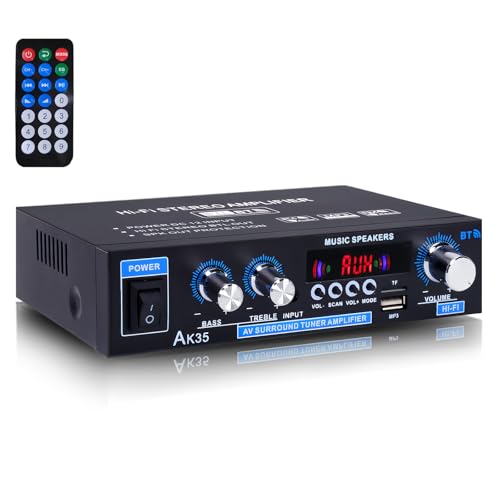
- ✓ Compact and stylish
- ✓ Powerful sound output
- ✓ Easy wireless streaming
- ✕ Limited for large spaces
- ✕ Not super loud
| Power Output | 30W RMS per channel, up to 100W + 100W peak |
| Channels | 2-channel stereo |
| Bluetooth Version | Bluetooth 5.0 |
| Input Options | USB, TF/microSD card, AUX |
| Speaker Compatibility | Passive speakers, up to 100W peak power handling |
| Controls | Bass, treble, master volume with remote control |
That sleek little WOOPKER AK35 has been sitting on my wishlist for a while, and when I finally plugged it in, I was curious to see if it could really fill my room with loud, clear music without taking up much space. It’s surprisingly compact—smaller than I expected—and fits comfortably on a shelf next to my other gear.
The matte black finish and minimalist design give it a modern, unobtrusive look that blends seamlessly into any setup.
First, I was impressed by the power output. With 30W RMS per channel and peaks up to 100W, it really packs a punch for a mini amp.
I tested it with my bookshelf speakers, and the sound was surprisingly rich and full—no distortion even at higher volumes. It handled bass and treble adjustments smoothly, thanks to the dedicated controls, so I could tailor the sound to my liking effortlessly.
The Bluetooth 5.0 feature worked like a charm. Pairing my phone took seconds, and the signal stayed stable even when I moved around the room.
Streaming my playlists wirelessly was seamless, and I appreciated the multiple inputs—USB, TF card, AUX—giving me plenty of options to connect various devices without hassle.
The remote control was a nice touch, letting me tweak volume or switch inputs without getting up. Overall, the AK35 feels like a practical upgrade for a small home setup.
It’s perfect if you want loud, clear music without cluttering your space with bulky equipment.
That said, it’s not meant for large, open spaces, and the maximum power isn’t super high, so don’t expect stadium-level volume. Still, for bedrooms, offices, or garages, it hits just the right note.
What Should You Consider When Selecting the Best Amplifier for Loud Music?
When selecting the best amplifier for loud music at home, there are several key factors to consider to ensure optimal performance and sound quality.
- Power Rating: Consider the amplifier’s power output, usually measured in watts, as this directly impacts how loud the music can get without distortion. A higher wattage generally means the amplifier can drive larger speakers effectively, allowing for a more dynamic listening experience.
- Speaker Compatibility: Ensure that the amplifier is compatible with your speakers in terms of impedance and power handling. Matching the amplifier’s output to the speakers’ requirements will prevent damage and ensure the best sound quality at high volumes.
- Type of Amplifier: There are various types of amplifiers, including tube, solid-state, and digital. Tube amplifiers often provide a warm sound, while solid-state amplifiers are known for their reliability and clarity, making them suitable for loud music.
- Cooling System: A good cooling system is essential, especially for amplifiers that handle high volumes. Look for models with adequate heat dissipation features to prevent overheating during extended play, which can affect performance and longevity.
- Additional Features: Consider extra features like built-in equalizers, Bluetooth connectivity, or multi-zone capabilities. These features can enhance your listening experience and make it easier to integrate the amplifier into your home audio setup.
- Brand Reputation: Research the brand’s reputation and customer reviews to gauge reliability and performance. Well-established brands often provide better customer service and warranty options, which can be crucial if issues arise.
- Budget: Determine your budget carefully, as amplifiers can vary significantly in price. More expensive models may offer advanced features and better sound quality, but it’s essential to find a balance between performance and what you can afford.
How Important is Power Output for Loud Music Performance?
Power output is a critical factor in selecting the best amplifier for loud music performance at home.
- Wattage: The wattage rating of an amplifier indicates how much power it can deliver to the speakers. Higher wattage means the amplifier can drive speakers to produce louder sound levels without distortion, making it essential for achieving high volume in larger spaces or during loud music performances.
- Dynamic Range: This refers to the difference between the quietest and loudest sounds an amplifier can produce. A wide dynamic range allows for deeper bass and clearer highs, which enhances the overall loudness and clarity during music playback, ensuring that even the most energetic tracks sound vibrant and engaging.
- Speaker Compatibility: The power output of an amplifier must match the speaker’s power handling capabilities. An amplifier with insufficient power can lead to distortion or damage to the speakers, while one that exceeds the speaker’s limits can create an unbalanced sound, emphasizing certain frequencies over others, which can reduce the quality of loud music performance.
- Clipping and Distortion: When an amplifier is pushed beyond its power limits, it can cause clipping, leading to a distorted sound that detracts from the listening experience. Choosing an amplifier with adequate power output helps avoid distortion, especially at high volumes, ensuring that music retains its clarity and impact.
- Efficiency: An amplifier’s efficiency rating affects how much power is converted into usable sound. More efficient amplifiers can produce higher volumes with less power, making them ideal for loud music performance, especially in home environments where energy consumption might be a concern.
What Role Does Speaker Compatibility Play in Enhancing Sound Quality?
Speaker compatibility is crucial for optimizing sound quality in a home audio setup, especially when selecting the best amplifier for loud music.
- Impedance Matching: Proper impedance matching between the amplifier and the speakers ensures that the amplifier can deliver the correct amount of power without distortion or damage. Amplifiers typically have a specified impedance rating, and using speakers that match this rating allows for efficient power transfer, resulting in clearer and louder sound.
- Power Handling: The power handling capacity of speakers must align with the output power of the amplifier to prevent clipping and distortion. If the amplifier produces more power than the speakers can handle, it can lead to speaker damage and compromised sound quality, especially when playing loud music.
- Sensitivity Ratings: Sensitivity ratings indicate how effectively a speaker converts power into sound. Choosing speakers with higher sensitivity ratings enables them to produce louder volumes with less power, making them ideal for pairing with amplifiers designed for loud music, as they can achieve desired sound levels without straining the system.
- Frequency Response: The frequency response range of speakers should complement the capabilities of the amplifier to ensure a balanced sound across all frequencies. If the amplifier excels in certain frequencies but the speakers cannot reproduce them well, it may result in an uneven sound profile, diminishing the overall listening experience.
- Cabinet Design: The design and materials used in speaker cabinets can affect compatibility with amplifiers. Well-designed cabinets can enhance sound quality by minimizing resonance and distortion, which is important for loud music playback, as it helps maintain clarity even at high volumes.
What Types of Amplifiers Are Most Suitable for Loud Music?
The most suitable types of amplifiers for loud music at home are:
- Class D Amplifiers: Class D amplifiers are highly efficient and can produce high power output while minimizing heat generation. They use pulse-width modulation to convert the audio signal, making them ideal for driving large speakers at high volumes without distortion.
- Class AB Amplifiers: Class AB amplifiers combine the efficiency of Class B with the low distortion of Class A, making them versatile for various music genres. They handle loud music well while maintaining fidelity, which is essential for clear sound during high-volume playback.
- Integrated Amplifiers: Integrated amplifiers combine a preamp and power amp in one unit, providing a compact solution for loud music setups. They often include features such as tone controls and built-in DACs, allowing users to optimize sound quality for their home listening environment.
- Power Amplifiers: Dedicated power amplifiers are designed solely to drive speakers with high wattage output, making them suitable for large home audio systems. They can handle substantial power loads, providing the necessary volume and clarity needed for loud music without compromising sound quality.
- Tube Amplifiers: While traditionally associated with lower power outputs, high-wattage tube amplifiers can deliver a warm sound that many audiophiles prefer. They often produce pleasant harmonic distortion that enhances the listening experience, especially for genres like rock and jazz, even at louder volumes.
What Are the Key Differences Between Tube and Solid-State Amplifiers?
| Aspect | Tube Amplifiers | Solid-State Amplifiers |
|---|---|---|
| Sound Quality | Warm, rich sound with harmonic distortion that many find pleasing. | Cleaner sound with higher fidelity and less distortion, ideal for accurate reproduction. |
| Durability | More fragile, sensitive to bumps and temperature changes, requiring careful handling. | More robust, can withstand physical stress and temperature variations with ease. |
| Maintenance | Requires frequent tube replacements and adjustments to maintain optimal performance. | Low maintenance, generally more reliable with minimal need for servicing. |
| Cost | Typically more expensive due to the cost of tubes and craftsmanship involved. | Generally more affordable with a wider range of budget options available. |
| Weight and Portability | Generally heavier and less portable due to larger components. | Lighter and more portable, making them easier to transport. |
| Power Consumption | Typically consume more power, which can lead to higher electricity costs. | More energy-efficient, consuming less power during operation. |
| Best Use Cases | Preferred for genres like jazz and classical where warmth is desired. | Better suited for rock, pop, and electronic music for their clarity and punch. |
| Lifespan | Tubes have a finite lifespan and will need replacement every few years. | Longer lifespan with fewer components that wear out. |
How Do Class D Amplifiers Perform at High Volumes?
Class D amplifiers are known for their efficiency and performance at high volumes, making them a popular choice for loud music at home.
- Efficiency: Class D amplifiers convert a high percentage of power into usable output, typically around 90% or higher. This efficiency allows them to produce loud sound levels without generating excessive heat, which is crucial for maintaining performance during extended listening sessions.
- Power Handling: These amplifiers often come with high power output capabilities, allowing them to drive large speakers and produce loud sound without distortion. The ability to handle significant power ensures that the sound remains clear and dynamic even when pushed to higher volume levels.
- Thermal Performance: Due to their design, Class D amplifiers maintain cooler operating temperatures compared to other types like Class A or Class AB. This is beneficial during high-volume playback, as it reduces the risk of thermal overload and allows for consistent performance without the risk of shutting down.
- Low Distortion: Class D amplifiers are designed to minimize signal distortion, which is particularly important at high volumes. They utilize pulse-width modulation to reproduce audio signals accurately, ensuring that music remains clear and free of artifacts when played loudly.
- Compact Size: The efficiency of Class D technology allows for more compact designs, making them easier to integrate into home audio systems without taking up much space. This is particularly advantageous for those looking to maximize sound output in smaller living areas.
Which Brands Are Renowned for Manufacturing High-Quality Amplifiers for Loud Music?
The top brands known for manufacturing high-quality amplifiers suitable for loud music at home include:
- Marantz: Renowned for their high-fidelity audio equipment, Marantz amplifiers deliver rich sound quality and robust performance, making them ideal for loud music. Their designs often incorporate advanced technology to minimize distortion and enhance clarity, ensuring an immersive listening experience at high volumes.
- Yamaha: Yamaha amplifiers are celebrated for their versatility and reliability, offering powerful output suitable for both home theater systems and music listening. With features like Music Enhancer technology, they optimize sound quality for various audio formats, making them a great choice for loud music enthusiasts.
- Pioneer: Pioneer is well-known for producing high-performance amplifiers that cater to audiophiles and casual listeners alike. Their amplifiers often include superior sound processing capabilities and robust build quality, ensuring they can handle loud music without sacrificing audio fidelity.
- Denon: Denon amplifiers are designed to provide premium sound quality and dynamic performance, making them excellent for loud music playback. With a focus on high-resolution audio and powerful amplification, Denon products are often favored by those who prioritize audio excellence in their home audio setups.
- Onkyo: Onkyo is recognized for its high-quality audio equipment that excels in delivering powerful sound. Their amplifiers often feature advanced circuitry for minimal distortion and exceptional sound staging, making them a popular choice for those who enjoy listening to music at high volumes.
- Rotel: Rotel amplifiers are known for their precision and power, making them a favorite among serious music lovers. Their commitment to high-quality components and engineering ensures that these amplifiers can handle loud music without compromising clarity or performance.
- Cambridge Audio: Cambridge Audio specializes in high-performance audio products, including amplifiers designed for loud music at home. Their amplifiers are built with high-quality materials and innovative technology that enhance sound quality, ensuring a satisfying listening experience at elevated volumes.
What Are the Features That Distinguish Top Brands in Loud Music Reproduction?
Dynamic range is another feature that plays a significant role in loud music reproduction, as it allows the amplifier to handle fluctuations in sound intensity. This means that listeners can enjoy both the quiet and loud moments of music without losing detail or impact.
Sound clarity is vital for an enjoyable listening experience, particularly at high volumes where distortion can spoil the music. Quality amplifiers are designed to maintain clarity across all frequency ranges, ensuring that instruments and vocals can be distinctly heard.
Build quality affects not only the durability of the amplifier but also the sound output. High-quality materials and solid construction help minimize vibrations that can interfere with sound clarity and consistency, particularly at elevated volumes.
Connectivity options are increasingly important, as they provide flexibility for users to connect various devices easily. Amplifiers with multiple input types, such as RCA, optical, and Bluetooth, allow for seamless integration into any home audio setup.
Heat management is crucial for amplifiers operating at high volumes, as excessive heat can lead to performance issues or component damage. Effective cooling systems, like heatsinks and fans, help maintain optimal temperature levels during extended use.
Equalization features, such as adjustable bass and treble controls, enable users to customize their sound experience. This personal touch can significantly enhance the listening experience, allowing for adjustments based on room acoustics or personal preferences.
How Can You Optimize Your Home Setup for an Exceptional Loud Music Experience?
To create an exceptional loud music experience at home, proper optimization of your setup is crucial. Follow these guidelines to maximize audio quality and volume without distortion:
-
Choose the Right Amplifier: Select a powerful amplifier that can handle high decibel levels. Look for models with low total harmonic distortion (THD) ratings to ensure clear sound at high volumes.
-
Quality Speakers: Invest in high-efficiency speakers that can reproduce sound accurately at higher volumes. Floor-standing or bookshelf speakers typically deliver better performance than smaller models.
-
Room Acoustics: Arrange furniture and decor to minimize sound reflections and echoes. Soft materials like curtains and carpets can help absorb excess sound, while placing speakers away from walls aids in clearer audio output.
-
Speaker Placement: Ensure speakers are positioned at ear level and form an equilateral triangle with the listening position for optimal sound staging.
-
Use a Subwoofer: Adding a subwoofer enhances the bass response and makes loud music more impactful. Ensure it complements your existing speakers.
-
Calibrate Your System: Use sound calibration tools or software to fine-tune levels and EQ settings according to your room’s acoustics.
Implementing these strategies will elevate your home music experience, allowing you to enjoy loud music with depth and clarity.
What Impact Do Room Acoustics Have on Amplified Sound?
Absorption is vital for improving sound quality in a space; materials that soak up sound can help mitigate reflections and echoes, making the music clearer and more enjoyable at higher volumes. By strategically placing soft materials in the room, one can achieve a balanced sound profile that complements the amplifier’s output.
Diffraction refers to how sound waves bend around obstacles, which can affect how evenly sound is distributed in the room. If the sound encounters furniture or wall corners, some areas may experience louder or softer sound, making it essential to consider room layout when setting up an amplifier for optimal performance.
Resonance occurs when certain frequencies are amplified due to the room’s natural characteristics, which can lead to an overemphasis of specific sounds. Understanding these resonant frequencies can help in tuning the audio setup for a more balanced and pleasing auditory experience.
Bass response is particularly sensitive to room acoustics; low frequencies can be enhanced or diminished depending on how they interact with the room’s boundaries. A well-placed subwoofer and thoughtful room design can help ensure that bass levels are rich and full without overwhelming the other frequencies in the music.
How Can You Maximize Speaker Placement to Enhance Loud Music Listening?
- Positioning Relative to Walls: Placing speakers at least a few feet away from walls can prevent excessive bass buildup and reflections that muddy the sound quality.
- Listening Height: Positioning speakers at ear level when seated ensures that sound waves reach your ears directly, improving clarity and detail in the music.
- Triangular Arrangement: Arranging speakers and the listening position in a triangle allows for optimal soundstage and imaging, making the music feel more immersive.
- Avoiding Corners: Keeping speakers away from corners minimizes resonances that can lead to distorted sound, especially at high volumes.
- Experimenting with Angles: Angling speakers towards the listening position can enhance the stereo effect and provide a more dynamic listening experience.
Positioning speakers at least a few feet away from walls can prevent excessive bass buildup and reflections that muddy the sound quality. This distance allows sound waves to disperse more freely, leading to a clearer and more balanced audio experience, particularly when playing loud music.
Positioning speakers at ear level when seated ensures that sound waves reach your ears directly, improving clarity and detail in the music. When speakers are too low or too high, the sound can become skewed, diminishing the impact of the audio, especially during loud listening sessions.
Arranging speakers and the listening position in a triangle allows for optimal soundstage and imaging, making the music feel more immersive. This setup facilitates a more accurate representation of the audio, allowing the listener to experience the nuances of loud music as intended by the artists.
Keeping speakers away from corners minimizes resonances that can lead to distorted sound, especially at high volumes. Corners can amplify certain frequencies, creating an uneven listening experience that detracts from the enjoyment of loud music.
Angling speakers towards the listening position can enhance the stereo effect and provide a more dynamic listening experience. This slight adjustment can significantly improve how sound is perceived, making loud music feel more engaging and lively.
Related Post: