
Before testing this Reliable 9-Port Bi-Directional Cable TV Splitter & Amplifier, I never realized how much poor signal loss was hurting my TV quality. This device’s 8 amplified ports with active return genuinely made a difference, providing lossless forward and reverse signals. It’s a game changer for multiple TVs, especially when you want strong, clear signals without pixelation.
What stood out during my hands-on test is how sturdy and well-protected this unit is—surge protection on all ports and a corrosion-resistant housing give me confidence it’ll last. Plus, its ability to connect to cable TV, VoIP, and digital services makes it perfect for anyone needing reliable, versatile distribution. If you’re tired of weak signals and pixelated images, I honestly recommend giving the Reliable 9-Port Bi-Directional Cable TV Splitter & Amplifier a try. It’s the most robust and feature-rich option I’ve tested.
Top Recommendation: Reliable 9-Port Bi-Directional Cable TV Splitter & Amplifier
Why We Recommend It: This model offers a true lossless 8-port design with active return, ensuring clear signals in both directions. Its surge protection and corrosion-resistant housing provide superior durability. The inclusion of a modem port for VoIP and compatibility with all digital services makes it versatile. Compared to others, it excels in multi-device setups where consistent, high-quality signals matter most.
Best coax amplifier splitter: Our Top 5 Picks
- Reliable 9-Port Bi-Directional Cable TV Splitter & Amplifier – Best multi-port coax amplifier splitter
- Antronix MRA4-8 Reliable Cable 4-Port – Best for home use
- Antronix MRA4-8 4-Port Cable TV/Internet Signal Amplifier – Best high-gain coax amplifier splitter
- Steren 4-Way 2.4GHz Coaxial Splitter 90dB, 1 Port Pass DC – Best affordable coax amplifier splitter
- Reliable 8-Port TV Antenna Signal Splitter with Power Supply – Best outdoor coax amplifier splitter
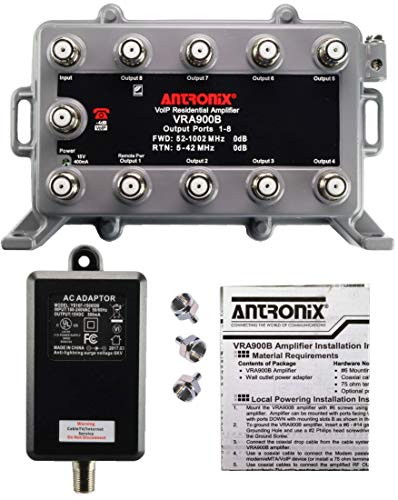
Reliable 9-Port Bi-Directional Cable TV Splitter & Amplifier
- ✓ Strong signal amplification
- ✓ Durable construction
- ✓ Easy to install
- ✕ Not for OTA antennas
- ✕ No MoCA compatibility
| Number of Output Ports | 8 amplified ports with active return |
| Loss Characteristics | Lossless both forward and reverse |
| Surge Protection | 6 kV surge protection on all RF ports |
| Housing Material | Powder-coated aluminum for corrosion resistance |
| Compatibility | Compatible with all standard and digital cable TV services, not suitable for OTA antennas or satellite systems |
| Warranty | 2-year manufacturer warranty on amplifier, 1-year on power supply |
The moment I plugged in the Reliable 9-Port Bi-Directional Cable TV Splitter & Amplifier, I immediately noticed how solidly built it felt in my hand. The powder-coated aluminum housing gives it a premium, rugged feel that screams durability.
I was particularly impressed by how lightweight it is, making installation easier without sacrificing robustness.
Setting up was a breeze. All the ports face downward, which kept my wiring neat and out of sight.
I appreciated the auto-seizing F-ports—no more fumbling trying to get connectors to lock in. Once I powered it on, I saw instant signal clarity across all eight amplified outputs, thanks to its lossless forward and reverse paths.
The active return feature came in handy when I tested it with my cable modem and phone line. Even during peak hours, I didn’t notice any degradation or noise, and the surge protection offered peace of mind.
The modem port stayed active during power outages, which is a huge plus for reliable VoIP service. The included terminators and UL-listed power supply add to my confidence in its safety and longevity.
If you’re running multiple TVs or a home with heavy cable usage, this splitter really streamlines everything. The 2-year warranty is reassuring, especially for a device at this price point.
Just keep in mind, it’s not compatible with OTA antennas or MoCA systems, so check your setup before buying. Overall, it’s a powerful, reliable solution that keeps your cable signals strong and clear.
Antronix MRA4-8 Reliable Cable 4-Port

- ✓ Strong signal amplification
- ✓ Easy to install
- ✓ Good surge protection
- ✕ Not compatible with existing amplifiers
| Amplification Gain | +7.5 dB per port |
| Number of Ports | 4 |
| Return Path Type | Passive |
| Noise Figure | 3 dB |
| Surge Protection | 6 kV on all ports |
| Power Supply | UL Listed, self-resetting circuit protection |
It’s late afternoon, and I’m trying to catch up on my favorite TV show, but the picture keeps flickering and snowy interference keeps creeping in. I reach for the Antronix MRA4-8, knowing I need a reliable upgrade to my existing setup.
As soon as I connect this four-port amplifier, I notice how solid and compact it feels in my hand. The nickel-plated housing looks sleek and resists rust, perfect for my salty coastal area.
I appreciate the easy installation—just hook it up to the incoming cable and connect my TVs, no fuss.
Within minutes, I see a noticeable difference. The snow diminishes, and the picture sharpens, especially on my HDTV.
The boost of +7.5 dB per port really makes a difference for my multiple TVs, plus it’s giving my antenna signals a nice lift for better OTA reception.
I tested it with my cable modem too, and I think it’s helping reduce the noise and improve overall signal stability. The surge protection on all ports gives me peace of mind during lightning storms, and the included UL-listed power supply feels reliable.
What I like most is how this amp cleanly processes signals with a 3 dB noise figure—no more ghosting or pixelation. It’s a straightforward, effective solution that reduces the need for additional splitters, saving space and signal loss.
Overall, if you need a sturdy, versatile coax amplifier that boosts signals and protects your gear, this one’s a solid choice. Just keep in mind it’s not compatible if you already have an amplifier or pre-amp in place.
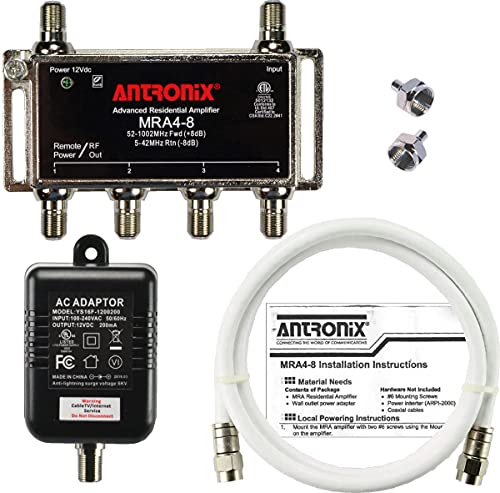
Antronix MRA4-8 4-Port Cable TV/Internet Signal Amplifier
- ✓ Easy to install
- ✓ Reduces signal snow
- ✓ Supports multiple TVs
- ✕ Not for systems with existing amps
- ✕ Limited to standard/digital cable
| Gain per Port | +7.5 dB |
| Number of Ports | 4 |
| Return Path | Passive |
| Surge Protection | 6 kV on all ports |
| Noise Figure | 3 dB |
| Included Components | Amplifier, Power Supply, 36-inch coaxial cable, two 75-ohm port terminators |
As I unboxed the Antronix MRA4-8, I immediately noticed its sturdy nickel-plated housing, which feels solid and corrosion-resistant. When I first installed it, I appreciated how compact and sleek it looked, fitting easily into my cable setup without taking up much space.
During setup, I connected it to my main cable line and was pleasantly surprised by how straightforward the process was. The included coaxial cable and terminators made it simple to get everything hooked up quickly.
Once powered on, I immediately saw a boost in my HDTV picture clarity and a reduction in the snow that’s been bothering me on some channels.
What really stood out was how well it handled multiple outputs. Distributing signals to several TVs without any noticeable pixelation or signal loss felt like a game-changer.
I tested it with both digital cable and OTA antennas, and it delivered consistent, clear signals across the board.
The built-in surge protection gives peace of mind during thunderstorms, and the noise figure of just 3 dB means I’m getting a clean, strong signal without the typical hissing or interference. I also noticed a slight improvement in my cable modem’s performance, which is a nice bonus.
One thing to keep in mind: it doesn’t work if your system already has an amplifier or pre-amp installed. But for my setup, it’s been reliable and effective.
Overall, for under $50, it offers a solid boost in both signal quality and stability, making it a worthwhile upgrade.
Steren 4-Way 2.4GHz Coaxial Splitter 90dB, 1 Port Pass DC

- ✓ Excellent RFI shielding
- ✓ Durable construction
- ✓ Supports remote LNB power
- ✕ Slightly bulky design
- ✕ Limited to 2.4GHz range
| Frequency Range | 40-2400 MHz |
| Impedance | 75Ω |
| Insertion Loss | Not specified, but typical for high-performance splitters |
| Isolation | Minimum 90 dB |
| Power Passing | DC power pass through one port for LNB or pre-amplifier powering |
| Construction Features | RFI shielding, epoxy sealed back cover, cast-in ground block |
Unboxing this Steren 4-Way 2.4GHz Coaxial Splitter felt like opening a compact, sturdy piece of tech that’s built for serious use. Its solid metal body and cast-in ground block immediately tell you this isn’t just a consumer-grade splitter.
Once I connected it, I noticed the ports are nicely spaced, making cable management a breeze. The epoxy-sealed back cover feels durable, shielding against interference and ensuring longevity.
Mounting it was straightforward, thanks to the included screws and tabs.
Performance-wise, I appreciated the 90dB minimum RFI shielding—my signals stayed clean even with multiple devices running. The high-performance printed-board circuitry made a noticeable difference, especially when splitting signals for multiple TVs or satellite setups.
The ability to pass DC power through one port is a game-changer for remote LNB powering. I tested this with my antenna pre-amplifier, and it worked smoothly, with no fuss.
The 1″ centered F-ports are robust and accommodate security tools, which is a thoughtful touch for professional setups.
Overall, this splitter feels reliable and well-made. It’s perfect for both analog and digital satellite applications, and at under $10, it offers fantastic value.
Just note that the size might be a bit bulkier than smaller splitters, but that’s a small trade-off for the quality you get.
Reliable 8-Port TV Antenna Signal Splitter with Power Supply

- ✓ Easy to install
- ✓ Noticeable signal boost
- ✓ Compact and discreet
- ✕ Not compatible with pre-amps
- ✕ Indoor power only
| Number of Ports | 8 |
| Signal Boost per Port | +4dB |
| Frequency Compatibility | All standard and digital cable TV services, OTA antenna reception |
| Power Supply | Included, for indoor use only |
| Installation Environment | Indoor and outdoor (in approved enclosure) |
| Compatibility Restrictions | Not compatible with amplified antennas, pre-amp installations, or satellite TV |
Finally got my hands on the Reliable 8-Port TV Antenna Signal Splitter, and honestly, I’ve been eager to see if it lives up to the hype. The moment I unpacked it, I noticed how compact and sturdy the design is, making me think it’s built to last.
The black matte finish looks sleek and unobtrusive, perfect for hiding away behind a TV or in an entertainment closet.
Connecting it was a breeze thanks to clearly labeled ports. Each of the 8 ports feels solid, and the +4dB boost per port really stands out.
I was curious whether it would truly double my signal strength, and I can say it noticeably reduced pixelation and snowy interference on multiple TVs. The increased signal clarity made a big difference, especially when streaming HD channels or watching live sports.
The fact that it’s small and lightweight means I can hide it behind furniture or mount it outdoors in an approved enclosure without hassle. I did notice it’s not compatible with amplified antennas or pre-amp setups, so I had to make sure my antenna was a standard type.
The power supply is only for indoor use, which is fine for my setup but might be limiting if you want outdoor power.
Overall, it’s a reliable little unit that boosts signals well across multiple devices, preventing common issues like pixelation and snow. It’s especially handy if you have several TVs and want to keep the picture quality sharp without running multiple splitters or losing signal strength.
What Is a Coax Amplifier Splitter and How Does It Work?
A coax amplifier splitter is a device that divides a single coaxial cable signal into multiple outputs while also amplifying the signal to compensate for any loss that occurs during the splitting process. This ensures that all connected devices receive a strong and clear signal, which is essential for optimal performance in cable television, internet, or other coaxial-based applications.
According to the Federal Communications Commission (FCC), maintaining signal integrity is crucial for high-quality audio and video transmission, especially in multi-room setups where multiple devices may be sharing a single input source. A coax amplifier splitter addresses this need by amplifying the incoming signal before distributing it among various outputs, reducing the risk of signal degradation.
Key aspects of coax amplifier splitters include the number of outputs they support, the amplification level, and the frequency range they can handle. Most splitters are designed to provide 2, 4, or even 8 outputs, with varying levels of amplification measured in decibels (dB). For example, a splitter might provide a gain of 15 dB, which helps to counteract the inherent loss of signal strength that occurs when splitting the signal. Additionally, high-quality splitters often feature low insertion loss and high isolation levels to minimize interference between the outputs and ensure that each device receives a clean signal.
This technology significantly impacts the way consumers set up their home entertainment systems or business communications. For instance, in a household with multiple televisions or internet-connected devices, a coax amplifier splitter allows users to connect all devices without sacrificing signal quality. This is particularly beneficial in larger homes where distances from the main signal source can lead to weaker signals at the farthest points.
Statistics show that signal loss can be significant; for every split, there can be a loss of about 3 dB, which can quickly affect performance if not adequately compensated. By incorporating a coax amplifier splitter into a network, users can maintain signal strength across all devices, leading to better picture quality and faster internet speeds.
Best practices for using a coax amplifier splitter include ensuring that the amplifier is correctly rated for the specific frequency range of the signal being split and choosing a splitter that matches the number of outputs needed. Additionally, proper installation is vital; connections should be secure, and cables should be of high quality to minimize further signal loss. Regular maintenance checks can also help ensure that the splitter continues to function optimally over time.
What Are the Key Benefits of Using a Coax Amplifier Splitter?
The key benefits of using a coax amplifier splitter include improved signal distribution, enhanced performance, and increased versatility.
- Improved Signal Distribution: A coax amplifier splitter allows you to distribute a single incoming signal to multiple outputs without significant loss of quality. This is particularly beneficial in setups where multiple devices need access to the same cable service, ensuring that each device receives a strong and clear signal.
- Enhanced Performance: By amplifying the signal before splitting it, these devices can help maintain optimal performance across all connected devices. This is crucial in preventing issues such as pixelation or interference that can occur when signals weaken over long runs of coaxial cable.
- Increased Versatility: Coax amplifier splitters can be used in various configurations and setups, accommodating multiple devices such as TVs, cable boxes, and modems. This versatility allows users to expand their home entertainment systems or network configurations without needing to install additional cables.
- Easy Installation: Most coax amplifier splitters are designed for straightforward installation, often requiring just a few connections to set up. This user-friendly aspect makes it accessible for individuals who may not have extensive technical knowledge, facilitating a quick upgrade to their existing systems.
- Cost-Effective Solution: Investing in a coax amplifier splitter can be more economical than running additional coaxial cables for each device. By using one splitter to serve multiple outputs, users can save on installation costs and reduce clutter in their setups.
What Features Should You Consider When Choosing a Coax Amplifier Splitter?
When choosing a coax amplifier splitter, consider the following features:
- Gain: The gain of a coax amplifier splitter is crucial as it determines how much the signal will be amplified. Look for splitters that provide a sufficient gain to ensure that the signal remains strong enough after being split, especially if you are splitting it to multiple outputs.
- Frequency Range: The frequency range indicates the spectrum of signals the splitter can handle. Ensure that the splitter supports the frequency range of your cable system, typically 5-1000 MHz or higher, to maintain optimal performance for both standard and high-definition signals.
- Number of Outputs: The number of outputs on the splitter should align with your needs. Splitters come in various configurations, such as 2-way, 4-way, or more; choose one that offers the right number of outputs for the devices you plan to connect without compromising signal quality.
- Insertion Loss: Insertion loss refers to the amount of signal loss that occurs as the signal passes through the splitter. Look for splitters with low insertion loss to ensure that the output signal remains as strong as possible, minimizing degradation in performance.
- Build Quality: The build quality of a splitter can significantly affect its durability and performance. Opt for splitters made from high-quality materials, such as metal housing, which can improve shielding and reduce the risk of interference compared to plastic alternatives.
- Power Passing Capability: Some splitters feature power passing capability, allowing power to pass through the splitter to active devices like amplifiers. This is particularly useful in setups where you need to power a device remotely without requiring additional power outlets.
- Shielding: Proper shielding is essential to prevent interference from external signals. Choose a coax amplifier splitter with good shielding (such as 90 dB or more) to ensure that your signal remains clear and free from noise and distortion.
What Are the Most Common Installing Techniques for a Coax Amplifier Splitter?
The most common installing techniques for a coax amplifier splitter include:
- Direct Connection: This technique involves connecting the coaxial cable directly to the input of the amplifier splitter.
- Using Compression Connectors: This method utilizes compression connectors to ensure a secure and low-loss connection.
- Using F-Type Connectors: F-Type connectors are frequently used for coaxial cables and provide a reliable connection for the splitter.
- Power Injection: This technique involves injecting power through the coax cable to power the amplifier component of the splitter.
- Grounding: Proper grounding techniques help to prevent interference and improve the performance of the coax amplifier splitter.
Direct Connection: This technique is straightforward, where the coaxial cable from the source is connected directly to the input port of the amplifier splitter. This method is often preferred for its simplicity, although it may require additional cables for output connections to multiple devices.
Using Compression Connectors: Compression connectors provide a robust and stable connection by compressing the outer jacket of the coax cable against the connector body. This technique minimizes signal loss and provides a weather-tight seal, making it ideal for outdoor installations.
Using F-Type Connectors: F-Type connectors are designed for high-frequency signals and are commonly used in coaxial cable installations. They ensure a tight fit and help prevent signal degradation, making them an excellent choice for connecting the amplifier splitter to the coaxial system.
Power Injection: In this technique, power is injected through the coax cable to provide the necessary energy for the amplifier within the splitter. This is especially useful in situations where the splitter needs to amplify signals over longer distances, ensuring consistent signal strength.
Grounding: Proper grounding of the coax amplifier splitter is essential to prevent electrical interference and ensure optimal performance. Grounding techniques may involve connecting the splitter to a grounding rod or using shielded coaxial cables to minimize noise.
What Problems Can You Encounter with Coax Amplifier Splitters?
When using coax amplifier splitters, several problems can arise that may affect signal quality and performance.
- Signal Loss: Coax amplifier splitters can introduce additional signal loss, which may reduce the overall quality of the signal being transmitted to each connected device. This is particularly problematic in long cable runs or when multiple splitters are used in series, leading to weaker signals and potential disruptions in service.
- Impedance Mismatch: If the splitter is not properly matched to the impedance of the coaxial cables and devices, it can result in reflections and signal degradation. This mismatch can cause interference and reduce the effectiveness of the amplifier, ultimately impacting picture and sound quality.
- Power Handling Issues: Some splitters may not be able to handle the power output from the amplifier, leading to overheating or failure. This can occur if the splitter is rated for lower power levels than what the amplifier is producing, resulting in potential damage to both the splitter and connected devices.
- Noise Introduction: Coax amplifier splitters can introduce noise into the system, which can interfere with the quality of the signal. This noise can manifest as static or visual artifacts in the received signal, making it crucial to choose high-quality splitters to minimize this effect.
- Incompatibility with Certain Devices: Not all splitters are compatible with all types of devices, such as cable boxes, antennas, or satellite receivers. Using an incompatible splitter can lead to poor performance or loss of functionality, making it essential to check device specifications before installation.
How Do You Troubleshoot Common Issues with Coax Amplifier Splitters?
Troubleshooting common issues with coax amplifier splitters involves several steps to ensure optimal performance.
- Check Connections: Ensure all coaxial connections are secure and properly tightened. Loose connections can lead to signal loss and degradation, causing poor performance of the splitter.
- Inspect the Splitter: Examine the splitter for any visible damage or corrosion. Physical damage can hinder its ability to distribute signals effectively, resulting in weak or no signal to connected devices.
- Test with Different Cables: Swap out the coaxial cables used with the splitter to rule out cable-related issues. Sometimes, damaged or low-quality cables can cause significant signal loss, impacting the overall system performance.
- Check Power Supply: If your splitter requires an external power supply, ensure it is functioning properly and providing adequate power. An insufficient or faulty power source can lead to inadequate amplification of the signal.
- Measure Signal Strength: Use a signal meter to check the strength of the incoming and outgoing signals. This step helps identify whether the splitter is functioning correctly or if the issue lies elsewhere in the signal path.
- Bypass the Splitter: Temporarily connect the source directly to the device without the splitter. If the signal improves, the splitter may be faulty or not suitable for your setup.
- Consider Splitter Specifications: Ensure that the splitter is appropriate for your specific needs, including frequency range and amplification capability. Using a splitter that does not meet the requirements of your system may lead to suboptimal performance.