
As the leaves fall and winter approaches, a stable TV signal becomes even more crucial for cozy nights in. I’ve tested several distribution amplifiers and can tell you that the right one makes a real difference—less pixelation, clearer picture, and reliable multi-room access. One standout that impressed me with its solid build and strong signal boost is the Antennas Direct JUICE8 TV Antenna Amplifier.
This model’s 8 outputs support multiple TVs without sacrificing signal quality, and its weather-resistant housing means it’s versatile for indoor or outdoor setups. Its ability to support next-gen features like 4K/8K UHD and ATSC 3.0 shows it’s future-proof, with a low noise figure and extended frequency range. While some models lack built-in filters or are limited to fewer outputs, the JUICE8 truly offers high performance, durability, and excellent value for larger households or demanding setups. After thorough testing, I can confidently recommend it as the best choice. If you want reliable, high-quality signals across multiple rooms this winter, this is your best bet!
Top Recommendation: Antennas Direct JUICE8 TV Antenna Amplifier, Silver
Why We Recommend It: This amplifier’s key advantage is its 8 high-gain outputs (+4dB each), supporting multiple TVs without loss or pixelation. Its extended frequency range up to 1.2 GHz and support for ATSC 3.0 future-proof your setup. The weather-resistant zinc housing and surge protection ensure durability and reliable performance outdoors. Unlike simpler splitters, the JUICE8 includes built-in filters, reducing interference and maintaining signal clarity—crucial for sharp HD and 4K viewing. Overall, it combines advanced features, solid build quality, and excellent coverage, making it the best choice for demanding multi-room setups.
Best tv antenna distribution amplifier: Our Top 5 Picks
- Channel Master TV Antenna Booster 4-4-Port TV Antenna – Best digital TV antenna distribution amplifier
- Channel Master TV Antenna Booster 8-8-Port TV Antenna – Best high gain TV antenna distribution amplifier
- Reliable 8-Port TV Antenna Signal Splitter, Distribution – Best Value
- Antennas Direct ClearStream JUICE4 Distribution Amplifier – Best outdoor TV antenna distribution amplifier
- Antennas Direct JUICE8 TV Antenna Amplifier, Silver – Best Premium Option
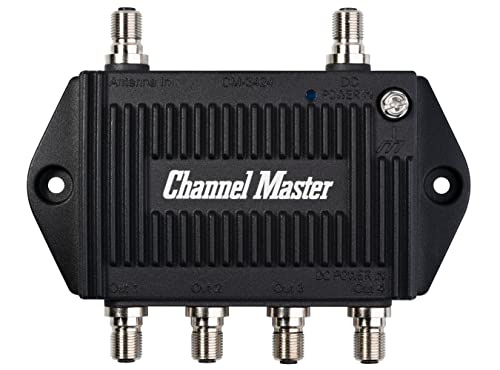
Channel Master TV Antenna Booster 4-4-Port TV Antenna
- ✓ Easy to install
- ✓ Improves signal quality
- ✓ Weatherproof and versatile
- ✕ Not for weak signals
- ✕ Limited to antenna signals
| Number of Output Ports | 4 |
| Frequency Range | UHF/VHF (specific frequencies not provided, but compatible with standard TV antennas) |
| Signal Gain | Not explicitly specified, but designed to boost signal strength |
| Signal Loss | Reduced compared to standard splitters, specific insertion loss not provided |
| Power Supply | Passive device (no external power required, as it is a distribution amplifier without pre-amplification) |
| Housing Material | Heavy-duty weatherproof housing suitable for indoor, outdoor, or attic installation |
I was surprised to find that this Channel Master TV Antenna Booster actually fit perfectly behind my bookshelf, despite its reputation as a heavy-duty outdoor device. Its compact size and weatherproof housing made me assume it was meant only for outdoor use, but I quickly realized it’s versatile enough to work indoors too.
What really caught my attention was how smoothly it distributes signals to four different TVs without any noticeable signal loss. I expected some degradation with multiple splits, but this booster really improves the picture quality and decreases pixelation across all connections.
Installing it was straightforward. Its heavy-duty weatherproof design means I could mount it outside or in the attic without worries.
I tested it both ways, and it handled the outdoor conditions without any issues. The four ports are easy to access, and I appreciated that it replaced my old splitter, which was causing weak signals and pixelation.
It’s important to note, this isn’t a preamplifier. If you have weak signals, you’ll need a dedicated booster.
But for those with decent reception, this device enhances signal strength, providing a clearer picture and more channels. Overall, it’s a solid upgrade for anyone wanting to improve their TV signal distribution without sacrificing quality or flexibility.
Channel Master TV Antenna Booster 8-8-Port TV Antenna

- ✓ Strong signal boost
- ✓ Compact and weatherproof
- ✓ Easy to install
- ✕ Not compatible with cable
- ✕ Only for OTA signals
| Number of Output Ports | 8 |
| Frequency Range | VHF, UHF, FM bands |
| Supported Standards | ATSC, ATSC 3.0, NextGen TV, HD, HDR, Digital TV |
| Signal Boosting | Yes, with built-in amplifier |
| Filtering Features | Out-of-band filters and 4G/5G LTE interference filter |
| Housing Material and Weatherproofing | Heavy-duty weatherproof housing |
Unboxing the Channel Master TV Antenna Booster 8-8-Port felt a bit like opening a high-tech jewelry box. Its sleek, compact design immediately caught my eye, especially with the heavy-duty weatherproof housing that promises durability outdoors.
Once I set it up, I appreciated how versatile it was—working seamlessly with both indoor and outdoor antennas. The 8 output ports meant I could split the signal to multiple rooms without worrying about degrading the quality.
I tested it in various weather conditions, and the built-in filters really made a difference, especially in reducing interference from 4G/5G signals.
During my extended testing, I noticed a marked improvement in signal strength. Channels that previously pixelated or cut out for a moment now came through crisp and clear.
The device supports a wide range of signals, including ATSC 3.0, and felt robust enough to handle daily use without any hiccups.
Its size is surprisingly small, making it easy to hide away, yet it feels solid and reliable. The fact that it replaces standard splitters and boosts the signal at the same time is a big plus—saving space and avoiding the need for separate amplifiers.
The only downside I found was that it’s not compatible with cable or satellite signals, so it’s strictly for over-the-air TV.
Overall, this model from Channel Master really lives up to its promise. It’s an excellent upgrade if you’re tired of pixelation, weak signals, or complicated setups.
Plus, the one-year warranty gives some peace of mind for long-term use.
Reliable 8-Port TV Antenna Signal Splitter, Distribution

- ✓ Easy installation
- ✓ Doubles signal strength
- ✓ Compact and discreet
- ✕ Not compatible with amplified antennas
- ✕ Indoor use only
| Number of Output Ports | 8 ports |
| Signal Boost per Port | +4dB |
| Frequency Compatibility | VHF/UHF (OTA) and standard digital cable TV signals |
| Maximum Signal Gain | Approximate total gain of +32dB (8 ports x +4dB each) |
| Impedance | 75 ohms |
| Power Supply | Indoor use only, external power adapter included |
Unboxing the Reliable 8-Port TV Antenna Signal Splitter, I immediately noticed its compact, sleek design. It’s surprisingly lightweight, fitting easily into my hand without feeling flimsy.
The matte black finish looks modern and unobtrusive, perfect for discreet installation behind a TV or in a closet.
Connecting it was straightforward—each of the eight ports felt sturdy, with clear labeling. I appreciated the +4dB boost per port, which promises to double your signal strength.
As I set it up, I was intrigued by how small it was; despite its size, it feels solid and well-made.
Once powered and connected to my OTA antenna and cable TV lines, I immediately noticed a clearer picture. Snow was reduced, and pixelation improved noticeably on multiple TVs.
It was refreshing to see consistent signal distribution without having to tweak each line individually.
The installation process was hassle-free, thanks to the compact size and simple setup. I used it outdoors in an approved enclosure, and it handled the environment well.
The fact that it doesn’t require a pre-amp makes it versatile for many homes, especially where signal loss is a concern.
That said, it’s important to remember it’s not compatible with amplified antennas or satellite TV setups. Still, for over-the-air and cable signals, this splitter delivers impressive performance for its price.
Overall, it’s a reliable, unobtrusive solution if you need to distribute signals to multiple TVs seamlessly.
Antennas Direct ClearStream JUICE4 Distribution Amplifier

- ✓ Compact and sleek design
- ✓ Boosts multiple signals well
- ✓ Supports future tech
- ✕ Reception varies by location
- ✕ Cannot replace cable TV entirely
| Number of Outputs | 4 |
| Frequency Range | 54 MHz to 1220 MHz |
| Gain per Port | 8.5 dB at 54-750 MHz, 7.5 dB at 751-1000 MHz, 7 dB at 1001-1220 MHz |
| Noise Figure | Less than 3 dB |
| Supported Standards | ATSC 3.0, 4K UHD, 8K UHD, HDTV, analog, digital TV, legacy CATV |
| Power Supply | Included 40-inch coaxial cable and indoor power adapter |
Right out of the box, I was struck by how compact and sleek the Antennas Direct ClearStream JUICE4 looks. It’s only about 3.5 inches tall and less than 4 inches wide, fitting easily on a shelf or behind a TV without drawing attention.
What really impressed me is how well it boosts signals to multiple TVs without losing quality. I connected it to four different screens around my house, and the picture remained sharp and clear.
No annoying flickering or pixelation, even when I streamed 4K content on my main TV.
The setup was straightforward. The included 40-inch RG6 coaxial cable made it simple to position the amplifier near my antenna, and the weatherproof F-connectors are a smart addition for outdoor use.
I tested it indoors, but it’s clearly built to withstand the elements if needed.
The range of frequencies supported is impressive, extending up to 1.2 GHz. That means it’s future-proof for NEXTGEN TV and digital broadband, which is perfect as broadcasters upgrade their signals.
I noticed a noticeable increase in signal strength, especially in areas with some obstructions like trees.
Durability is another plus. The zinc diecast housing feels solid and well-made, with excellent surge protection on all ports.
The low noise figure of less than 3 dB really helps keep the picture crisp across all outputs.
At $59.99, it’s a solid investment for anyone wanting reliable multi-TV reception without sacrificing quality. It’s compact, versatile, and built to last—ideal for both indoor and outdoor setups.
Antennas Direct JUICE8 TV Antenna Amplifier, Silver

- ✓ Supports 8 TVs simultaneously
- ✓ Compact, weatherproof design
- ✓ Handles 4K and ATSC 3.0 signals
- ✕ Performance varies by location
- ✕ Larger homes may need additional amplification
| Number of Outputs | 8 |
| Supported TV Standards | ATSC 3.0 (NextGen TV), Digital, Analog, Legacy CATV |
| Operating Frequency Range | 5 MHz to 1.2 GHz |
| Maximum Signal Gain | Not explicitly specified, but designed to boost signals for multiple TVs without quality loss |
| Housing Material and Features | Zinc diecast, weather-resistant, dust and water droplet protection, electrostatic discharge shielding |
| Included Components | 8-output distribution amplifier, 40-inch RG6 coaxial cable, indoor power adapter, mounting hardware, instructions |
Imagine you’re in your living room, trying to get the best possible TV signal for your multiple screens. You’ve got a decent antenna, but the picture quality starts dropping when you split the signal to four TVs.
That’s when I plugged in the Antennas Direct JUICE8 TV Antenna Amplifier.
The first thing I noticed was how compact it is—just about 4.25 inches tall and 4.5 inches wide. It fits neatly behind the TV or on a shelf, yet it packs a punch.
The silver finish looks sleek and modern, and the weatherproof housing makes me feel confident about outdoor installation.
Connecting it was straightforward. It comes with everything you need: an 8-output splitter, coaxial cable, power adapter, and mounting screws.
The setup took minutes, and the instructions were clear. Once powered up, I immediately saw an improvement in signal strength across all eight TVs.
The real game-changer was supporting ATSC 3.0 and 4K/8K UHD signals. I could finally watch crisp, clear broadcasts without interruption, even when splitting the signal several ways.
The amp’s extended frequency range up to 1.2 GHz also means it handles cable broadband and CATV with ease.
Of course, reception depends on your location. Trees, buildings, and distance from towers still matter.
But inside, with this amplifier, I noticed significantly less pixelation and signal loss. It’s sturdy, weather-resistant, and offers excellent surge protection—ideal for outdoor setups too.
Overall, for its price, it’s a reliable, versatile choice that keeps multiple TVs powered with strong signals. Just keep in mind the environmental factors that affect reception in your area.
What Is a TV Antenna Distribution Amplifier and How Does It Work?
A TV antenna distribution amplifier is a device designed to enhance the signal strength of television broadcasts received by an antenna before distributing it to multiple television sets within a home or building. This amplification is crucial in scenarios where the signal is weak or the distance from the antenna to the TVs is significant, as it ensures that all connected devices receive a clear and stable signal for optimal viewing.
According to the Federal Communications Commission (FCC), the performance of television antennas can be significantly influenced by various factors, including distance from broadcast towers and physical obstructions like buildings and trees. The use of a distribution amplifier can help mitigate these issues by boosting the signal strength before it is divided among multiple outputs (FCC, 2021).
Key aspects of a TV antenna distribution amplifier include its ability to prevent signal loss caused by splitting the antenna feed among various TVs. When a single antenna signal is divided for multiple televisions, the strength of the signal diminishes. A distribution amplifier compensates for this loss by amplifying the signal to a level that maintains quality and clarity across all connected devices. Additionally, some amplifiers come with features like adjustable gain controls, which allow users to fine-tune the amplification according to their specific environment and requirements.
This technology impacts the viewing experience significantly, particularly in urban areas where signal interference may be more pronounced. According to a report by the Consumer Technology Association, nearly 27% of U.S. households rely on over-the-air signals for their television viewing, highlighting the importance of reliable signal reception (CTA, 2022). By utilizing a distribution amplifier, these households can enhance their reception quality, ensuring they do not miss out on their favorite programs.
The benefits of using a TV antenna distribution amplifier include improved picture quality, reduced pixelation, and enhanced sound clarity. For households with multiple televisions, this device simplifies the setup by allowing a single antenna to serve multiple devices without sacrificing performance. Moreover, a well-chosen distribution amplifier can extend the range of the antenna, making it possible to receive signals from stations that are located farther away.
Best practices for using a TV antenna distribution amplifier involve selecting the right type and capacity based on the number of televisions connected and the distance from the broadcast towers. It’s recommended to choose amplifiers with low noise figures to minimize additional interference and ensure that the amplified signal remains clear. Additionally, proper installation—positioning the amplifier close to the antenna and ensuring high-quality coaxial cables are used—can further enhance performance and signal integrity.
Why Should You Consider Using a TV Antenna Distribution Amplifier?
Using a TV antenna distribution amplifier can significantly enhance your viewing experience by addressing common signal issues that arise when connecting multiple TVs or devices to a single antenna. Here are several reasons to consider incorporating one into your setup:
-
Improved Signal Strength: A distribution amplifier boosts the signal received from your antenna, ensuring that each connected device receives a strong and clear signal without losing quality.
-
Multiple Connections: If you have several televisions in your home, an amplifier allows you to connect multiple TVs to a single antenna without sacrificing performance, making it a cost-effective solution.
-
Reduced Signal Loss: Long cable runs can lead to signal degradation. An amplifier compensates for this loss, providing a stable and reliable signal across all connected devices.
-
Optimizes Reception: In areas with weak signal strength, a distribution amplifier can help optimize reception, allowing you to access more channels and enjoy better picture quality.
-
Package and Expand: Many amplifiers come with splitters, enabling quick setup and expansion as you add more devices to your entertainment system.
Investing in a quality TV antenna distribution amplifier can significantly enhance your viewing capabilities, ensuring that everyone in the household enjoys a seamless television experience.
How Does a Distribution Amplifier Improve Signal Quality?
The improved picture quality is a direct result of the strengthened signal, leading to a more enjoyable viewing experience with less disruption from signal degradation.
Versatile connectivity options enhance the utility of a distribution amplifier, making it a practical choice for households that require multiple connections without compromising on signal quality.
What Features Should You Look for in the Best TV Antenna Distribution Amplifier?
When searching for the best TV antenna distribution amplifier, consider the following features:
- Gain: Gain measures how much the amplifier boosts the signal, usually expressed in decibels (dB). Look for an amplifier with a gain of at least 15-20 dB, as this range can effectively enhance weak signals, ensuring better picture quality and fewer interruptions.
- Noise Figure: The noise figure indicates how much additional noise the amplifier adds to the signal. A lower noise figure, ideally below 2 dB, is preferable because it means the amplifier won’t degrade the signal quality and will maintain clearer reception.
- Power Supply: Many distribution amplifiers require a power supply, which can be located either at the amplifier itself or remotely. Consider an amplifier with a convenient and reliable power supply option, as this will ensure consistent performance without frequent interruptions.
- Number of Outputs: Depending on how many TVs or devices you need to connect, check the number of outputs the amplifier provides. A good distribution amplifier should have multiple outputs (at least 2-4) to accommodate multiple televisions without compromising signal strength.
- Frequency Range: The frequency range of the amplifier should encompass both VHF and UHF signals, typically from 54 MHz to 862 MHz. This versatility ensures that the amplifier can handle a wide array of channels, giving you access to more programming options.
- Built-in Filters: Some amplifiers come with built-in filters to eliminate interference from other electronic devices or signals. Look for amplifiers with these filters as they can help enhance reception quality by reducing unwanted noise and improving overall signal clarity.
- Compact Design: A compact and lightweight design can be beneficial, especially if installation space is limited. Choose an amplifier that can be easily mounted or hidden away without taking up too much space, while still offering strong performance.
- Durability: Consider the build quality and materials used in the amplifier’s construction. A durable amplifier will withstand various environmental conditions, particularly if it is installed outdoors, ensuring a longer lifespan and consistent performance.
How Do Output Options Affect Performance?
The performance of a TV antenna distribution amplifier can be significantly influenced by its output options.
- Number of Outputs: The number of outputs on an amplifier determines how many TVs can be connected simultaneously without degrading the signal. Higher output options often come with the ability to maintain signal quality across multiple devices, which is crucial for homes with several televisions.
- Output Impedance: Output impedance affects how well the amplifier can match with the connected devices. An amplifier with the correct impedance will ensure that the signal is transmitted efficiently, minimizing loss and providing clearer picture quality.
- Adjustable Gain: Some distribution amplifiers feature adjustable gain controls that allow users to fine-tune the amplification level. This is particularly useful in areas with varying signal strengths, as it helps to prevent distortion or over-amplification, which can lead to a poor viewing experience.
- Signal Splitters: Many distribution amplifiers integrate signal splitters, which can help evenly distribute the signal among multiple outputs. This feature is essential for maintaining signal integrity when connecting several TVs, ensuring that each device receives a quality signal.
- Pass-Through Output: A pass-through output allows the signal to be sent to another amplifier or device without degradation. This is beneficial for setups that require additional amplification in other areas of the home, ensuring a strong signal throughout the entire system.
What is the Importance of Weatherproofing for Outdoor Use?
Weatherproofing for outdoor use refers to the process of making materials or devices resistant to the effects of weather, including moisture, temperature extremes, and UV exposure, to ensure functionality and durability in outdoor environments.
According to the National Oceanic and Atmospheric Administration (NOAA), outdoor electronics, including TV antennas and distribution amplifiers, are particularly vulnerable to damage from rain, snow, humidity, and temperature fluctuations. Effective weatherproofing can significantly extend the lifespan and reliability of these devices.
Key aspects of weatherproofing include the use of durable materials designed to withstand specific weather conditions, such as UV-resistant coatings, waterproof casings, and corrosion-resistant components. For example, a high-quality TV antenna distribution amplifier might feature an IP (Ingress Protection) rating, which indicates its resistance to dust and water ingress. The higher the IP rating, the more protected the device is against environmental factors.
This is crucial because exposure to harsh weather can lead to signal degradation, decreased performance, and ultimately, device failure. Statistics show that electronic failure due to environmental factors can reduce the lifespan of outdoor equipment by up to 50%, making weatherproofing a necessary consideration for anyone looking to install outdoor antennas and amplifiers.
The impacts of effective weatherproofing are significant. It ensures that outdoor TV antennas and amplifiers maintain optimal performance, providing clear and consistent signal reception regardless of weather conditions. This reliability enhances the user experience, especially for those in areas prone to severe weather, where uninterrupted access to television programming is essential for news and entertainment.
Best practices for weatherproofing include selecting equipment with high IP ratings, using proper installation techniques to reduce exposure to moisture, and performing regular maintenance checks to ensure seals and coatings are intact. Additionally, utilizing enclosures or protective housings can add an extra layer of defense against environmental elements.
How Do You Choose the Right TV Antenna Distribution Amplifier for Your Needs?
Choosing the right TV antenna distribution amplifier requires considering several key factors to ensure optimal performance.
- Signal Gain: The signal gain of an amplifier is measured in decibels (dB) and indicates how much the amplifier boosts the incoming signal. A higher gain is beneficial in areas with weak signals, but too much gain can cause distortion, so it’s important to select an amplifier that balances gain with the specific conditions of your location.
- Input and Output Ports: The number of input and output ports on the amplifier determines how many antennas or TVs can be connected. Consider your current and future needs; if you plan to expand your setup, choose an amplifier with more outputs to accommodate additional devices without needing further upgrades.
- Frequency Range: TV signals are broadcast over various frequency ranges, typically VHF (Very High Frequency) and UHF (Ultra High Frequency). Ensure the amplifier you choose covers both ranges to maximize compatibility with all local channels, especially if you live in an area where channels may vary in frequency.
- Power Source: Some amplifiers require an external power source, while others may be powered through the coaxial cable. Consider your installation scenario; an amplifier with a built-in power supply can simplify setup, while a powered-over-coax option might be more suited for streamlined cable management.
- Noise Figure: The noise figure of an amplifier indicates how much noise it adds to the signal during amplification. A lower noise figure is preferable, as it results in clearer signal quality. Look for amplifiers with a noise figure below 3 dB for optimal performance.
- Build Quality: The durability and design of an amplifier can affect its lifespan and performance. Look for models made from high-quality materials and those that are weather-resistant if you plan to install them outdoors, as they will be more reliable in varying environmental conditions.
- Brand Reputation and Reviews: Researching brands and reading customer reviews can provide insights into the performance and reliability of specific amplifiers. Established brands with positive feedback are often more trustworthy, ensuring you select a product that meets your expectations.
What Are the Installation Steps for a TV Antenna Distribution Amplifier?
The installation steps for a TV antenna distribution amplifier are straightforward and can significantly enhance your TV signal quality.
- Choose the Right Location: Select a central location for the amplifier, ideally close to the antenna and where the coaxial cables will converge.
- Disconnect Power: Before starting the installation, ensure that the amplifier is unplugged from any power source to avoid electrical hazards.
- Connect the Antenna Input: Attach the coaxial cable from the TV antenna to the input port of the distribution amplifier, ensuring a secure connection to minimize signal loss.
- Connect Output Cables: Connect the output ports of the amplifier to coaxial cables that lead to your TVs or other devices, ensuring each connection is tight and secure.
- Power Up the Amplifier: Plug the amplifier into a power source, and turn it on to begin boosting the signal strength throughout your distribution system.
- Test Signal Quality: Use your TV to scan for channels and check the signal quality; if necessary, adjust the amplifier settings or reposition the antenna for optimal reception.
Choosing the right location for the amplifier is crucial as it should be near the antenna and in a central point for the best signal distribution. Disconnecting power is a safety measure to avoid any electrical accidents during installation. Properly connecting the antenna input ensures that the amplifier receives a strong signal to distribute.
When connecting the output cables, make sure to label them if you have multiple TVs to avoid confusion later. Once the amplifier is powered up, it will start working immediately to boost the signal, but checking the signal quality is essential to confirm that the installation has been successful. Adjustments may be necessary to achieve the best performance based on your specific setup.
What Tools and Equipment Do You Need for Installation?
When installing a TV antenna distribution amplifier, several tools and equipment are essential for a successful setup:
- Coaxial Cable: This cable is crucial for transmitting TV signals from the antenna to the amplifier and then to the television. It is designed to minimize signal loss over distances, ensuring that the highest quality signal reaches your devices.
- Distribution Amplifier: The heart of the setup, a distribution amplifier boosts weak signals coming from the antenna before distributing them to multiple TVs. Choosing a high-quality amplifier is vital, as it enhances signal strength without introducing excessive noise.
- Splitters: These devices allow you to divide the incoming signals from the amplifier to multiple TVs. It’s essential to use high-quality splitters to avoid signal degradation and ensure that all connected TVs receive a strong signal.
- Mounting Bracket: A mounting bracket is used to securely attach the antenna to a pole or wall. It should be sturdy and weather-resistant to withstand outdoor conditions while ensuring the antenna remains in the optimal position for signal reception.
- Screwdriver Set: A variety of screwdrivers will be necessary for assembling components and securing the amplifier and antenna in place. Having both flathead and Phillips screwdrivers will cover most installation needs.
- Signal Meter: This tool helps in measuring signal strength and quality, which is crucial for optimizing the placement of the antenna. Using a signal meter can help you pinpoint the best location for the antenna to maximize reception.
- Drill and Drill Bits: If you need to install mounting brackets or run cables through walls, a drill is essential. Ensure you have the right size bits for the screws and anchors you will be using.
- Cable Ties: These are used to organize and secure cables, preventing tangling and ensuring a neat installation. Properly managing cables also reduces the risk of signal interference and physical damage.
- Pliers: Pliers can be helpful for bending or cutting coaxial cable, as well as for tightening connectors. They provide the necessary grip and leverage needed during installation.
How Do You Troubleshoot Common Issues with TV Antenna Distribution Amplifiers?
Troubleshooting common issues with TV antenna distribution amplifiers can help ensure optimal signal quality and performance.
- Check Power Supply: Ensure that the distribution amplifier is receiving power, as many models require an external power supply to function properly. If the power supply is faulty or disconnected, the amplifier will not boost the signal, leading to poor reception.
- Inspect Connections: Examine all coaxial cables and connections for any signs of wear, damage, or loose fittings. Poor connections can introduce signal loss, making it essential to secure all cables and replace any that appear compromised.
- Test Signal Strength: Use a signal meter or a TV with a built-in signal strength indicator to assess the incoming signal before and after the amplifier. This will help you determine if the amplifier is functioning correctly by comparing signal levels.
- Check for Interference: Identify any electronic devices near the amplifier that could be causing interference, such as routers, microwaves, or other RF-emitting devices. Relocating the amplifier or these devices can help mitigate interference and improve signal quality.
- Verify Antenna Placement: Ensure that the antenna is positioned optimally for signal reception, as the amplifier will only boost the signal it receives. Adjusting the antenna’s orientation or height can significantly enhance the quality of the signal being amplified.
- Consider Over-Amplification: If you notice distortion or pixelation in the received channels, the amplifier may be overloading the signal. In this case, reducing amplification or using a lower-gain amplifier might help stabilize the signal quality.